Question
A bar magnet takes $\frac{\pi}{10}$ second to complete one oscillation in an oscillation magnetometer. The moment of inertia of the magnet about the axis of rotation is $1.2 \times 10^{-4} \mathrm{~kg}-\mathrm{m}^2$ and the earth's horizontal magnetic field is $30\mu \text{T}.$ Find the magnetic moment of the magnet.
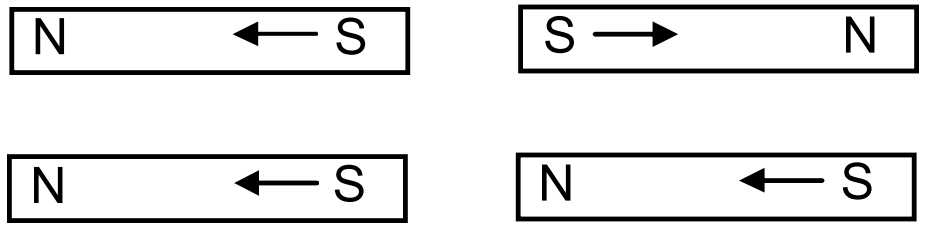

Answer

We know: $\text{v}=\frac{1}{2\pi}\sqrt{\frac}{\text{mB}_\text{H}}{\text{I}}$For like poles tied together
$M=M_1-M_2$
For unlike poles $\mathrm{M}^{\prime}=\mathrm{M}_1+\mathrm{M}_2$
$\frac{\text{v}_1}{\text{v}_2}=\sqrt{\frac{\text{M}_1-\text{M}_2}{\text{M} _1-\text{M}_2}}\Rightarrow\Big(\frac{10}{2}\Big)^2$
$=\frac{\text{M}_1-\text{M}_2}{\text{M}_1+\text{M}_2}\Rightarrow25=\frac{\text{M}_1-\text{M}_2}{\text{M}_1+\text{M}_2}$
$\Rightarrow\frac{26}{24}=\frac{2\text{M}_1}{2\text{M}_2}\Rightarrow\frac{\text{M}_1}{\text{M}_2}=\frac{13}{12}$

Need a full question paper?

Generate a complete, print-ready paper with questions like this in minutes — across 16+ boards, with answer keys.

Start Generating Free

Similar questions

The US athlete Florence Griffith-Joyner won the $100m$ sprint gold medal at Seol Olympic 1988 setting a new Olympic record of $10.54s$. Assume that she achieved her maximum speed in a very short-time and then ran the race with that speed till she crossed the line. Take her mass to be 50kg.
  1. Calculate the kinetic energy of Griffith-Joyner at her full speed.
  2. Assuming that the track, the wind etc. offered an average resistance of one tenth of her weight, calculate the work done by the resistance during the run.
  3. What power GriffithJoyner had to exert to maintain uniform speed?
The combination of two bar magnets makes 10 oscillations per second in an oscillation magnetometer when like poles are tied together and 2 oscillations per second when unlike poles are tied together. Find the ratio of the magnetic moments of the magnets. Neglect any induced magnetism.
You are holding a cage containing a bird. Do you have to make less effort if the bird flies from its position in the cage and manages to stay in the middle without touching the walls of the cage? Does it make a difference whether the cage is completely closed or it has rods to let air pass?
A plate current of 10mA is obtained when 60 volts are applied across a diode tube. Assuming the Langmuir-Child equation $\text{i}_\text{p}\propto\text{V}_\text{p}^{\frac{3}{2}}$ to hold, find the dynamic resistance $\text{r}_\text{p}$ in this operating condition.
The saturation current from a thoriated-tungsten cathode at 2000 K is 100 mA . What will be the saturation current for a pure-tungsten cathode of the same surface area operating at the same temperature? The constant A in the Richardson-Dushman equation is $60 \times 10^4 \mathrm{Am}^{-2} \mathrm{~K}^{-2}$ for pure tungsten and $3.0 \times 10^4 \mathrm{Am}^{-2} \mathrm{k}^{-2}$ for thoriated tungsten. The work function of pure tungsten is 4.5 eV and that of thoriated tungsten is 2.6 eV .
The ear-ring of a lady shown in has a 3cm long light suspension wire.
  1. Find the time period of small oscillations if the lady is standing on the ground.
  2. The lady now sits in a merry-go-round moving at 4m/s in a circle of radius 2m. Find the time period of small oscillations of the ear-ring.
A magnetic needle is free to rotate in a vertical plane which makes an angle of 60° with the magnetic meridian. If the needle stays in a direction making an angle of $\tan^{-1}\Big(\frac{2}{\sqrt{3}}\Big)$ with the horizontal, what would be the dip at that place?
The saturation current in a triode valve can be changed by changing:
  1. The grid voltage.
  2. The plate voltage.
  3. The separation between the grid and the cathode.
  4. The temperature of the cathode.
You are waiting for a train on a railway platform. Your three year old niece is standing on your iron trunk containing the luggage. Why does the trunk not recoil as she jumps off on the platform?
Read the passage given below and answer the following questions from 1 to 5.In physics, we can classify quantities as scalars or vectors. Basically, the difference is that a direction is associated with a vector but not with a scalar. A scalar quantity is a quantity with magnitude only. It is specified completely by a single number, along with the proper unit. Examples are: the distance between two points, mass of an object, the temperature of a body and the time at which a certain event happened. The rules for combining scalars are the rules of ordinary algebra. Scalars can be added, subtracted, multiplied and divided just as the ordinary numbers. A vector quantity is a quantity that has both a magnitude and a direction and obeys the triangle law of addition or equivalently the parallelogram law of addition. So, a vector is specified by giving its magnitude by a number and its direction. Some physical quantities that are represented by vectors are displacement, velocity, acceleration and force. Answer the following
  1. Force is example of:
  1. Scalar
  2. Vector
  3. Tensor
  4. None of these
  1. Mass of an object is:
  1. Scalar
  2. Vector
  3. Tensor
  4. None of these
  1. Define scalar quantity and vector quantity
  1. Can we add vectors like ordinary algebra? If not then how vectors are added?
  1. Differentiate between scalar and vectors