MCQ
A base is dissolved in water yields a solution with a hydroxide ion concentration of $0.05$  $mol\,\,litr{e^{ - 1}}.$ The solution is
  • Basic
  • B
    Acid
  • C
    Neutral
  • D
    Both $(a) $ and $(b)$

Answer

Correct option: A.
Basic
(a) $[O{H^ - }]$ion conc.$ = 0.05\frac{{mol}}{l}$ $ = 5 \times {10^{ - 2}}\frac{{mol}}{l}$

$pOH = - \log \,\,[O{H^ - }]$ $ = - \log \,\,[5 \times {10^{ - 2}}]$

$pOH = 1.30$; $pH + pOH = 14$

$pH = 14 - pOH $ $ = 14 - 1.30 = 12.7$

Need a full question paper?

Generate a complete, print-ready paper with questions like this in minutes — across 16+ boards, with answer keys.

Start Generating Free

Similar questions

The species that do not contain peroxide linkage are :-
The number of orbitals in $d$ sub-shell is
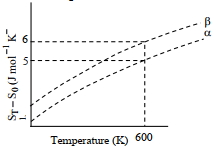
The entropy versus temperature plot for phases $\alpha$ and $\beta$ at 1 bar pressure is given. $S_{\mathrm{T}}$ and $S_0$ are entropies of the phases at temperatures $\mathrm{T}$ and $0 \mathrm{~K}$, respectively.

(image)

The transition temperature for $\alpha$ to $\beta$ phase change is $600 \mathrm{~K}$ and $C_{p, \beta}-C_{p, \alpha}=1 \mathrm{~J} \mathrm{~mol}^{-1} \mathrm{~K}^{-1}$. Assume $\left(C_{p, \beta}-C_{p, \alpha}\right)$ is independent of temperature in the range of 200 to $700 \mathrm{~K} . \mathrm{C}_{p, \alpha}$ and $C_{p, \beta}$ are heat capacities of $\alpha$ and $\beta$ phases, respectively.

($1$)The value of entropy change, $\mathrm{S}_\beta-\mathrm{S}_\alpha$ (in $\mathrm{J} \mathrm{mol}^{-1} \mathrm{~K}^{-1}$ ), at $300 \mathrm{~K}$ is. . . . . . .

[Use : $\ln 2=0.69$  Given : $S_\beta-S_\alpha=0$ at $\left.0 \mathrm{~K}\right]$

($2$) The value of enthalpy change, $\mathrm{H}_\beta-\mathrm{H}_\alpha$ (in $J$ mol ${ }^{-1}$ ), at $300 \mathrm{~K}$ is

Give the answer quetion ($1$) and ($2$)
Which property of water is used while washing clothes?
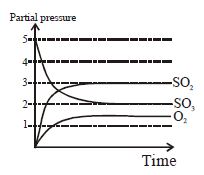
The dissociation of $SO_3(g)$ into $SO_2(g)$ & $O_2(g)$ is carried out in a closed container at a constant temperature $T$ . The equilibrium constant for the reaction is $K_P$ = $x\  atm^2$ . The partial pressure variation for the three gases is as shown 

The value of $x$ is

In the equilibrium, $\text{AB}\rightleftharpoons\text{A}+\text{B}$ if the equilibrium concentration of $A$ is double, then equilibrium concentration of $B$ will be:
Consider titration of $NaOH$ solution versus $1.25\, M$ oxalic acid solution. At the end point following burette readings were obtained.

$(i)$ $4.5\, mL$ $\quad (ii)$ $4.5\, mL$ $\quad (iii)$ $4.4\, mL$

$(iv)$ $4.4\, mL$ $\quad (v)$ $4.4\, mL$

If the volume of oxalic acid taken was $10.0 \,mL$ then the molarity of the $NaOH$ solution is .... $M.$ (Rounded-off to the nearest integer)

Based on Hess's law calculations, what is the average bond energy of $S-O$ in $SO_3$ if $\Delta H_f^o$ of $SO_3$ is $-270\, kJ\,mol^{-1}$. Bond energy of $O=O$ is $130\, kJ\,mol^{-1}$ and heat of sublimation for $S(s)$ is $100\, kJ\, mol^{-1}$ ? .....$kJ\,mol^{-1}$
The Bohr orbit radius for the hydrogen atom $(n = 1)$ is approximately $0.530\,\mathop A\limits^o $. The radius for the first excited state $(n = 2)$ orbit is ........... $\mathop {\rm{A}}\limits^{\rm{o}} $
Hydrogen atoms are held together to form hydrogen molecules by