MCQ
A batsman deflects a ball by an angle of $45^o$ without changing its initial speed which is equal to $54\; km/h$. What is the impulse imparted to the ball in $kg\;m/s$? (Mass of the ball is $0.15 \;kg.)$
  • A
    $6.8$
  • B
    $8.32$
  • C
    $2.8$
  • $4.16$

Answer

Correct option: D.
$4.16$
d
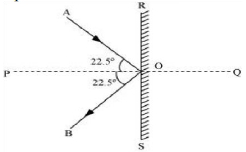
The given situation can be represented as shown in the following figure

Where, $AO =$ Incident path of the ball

$OB =$ Path followed by the ball after deflection

$\angle AOB =$ Angle between the incident and deflected paths of the ball $=45^{\circ}$

$\angle AOP =\angle BOP =22.5^{\circ}=\theta$

Initial and final velocities of the ball $=v$

Horizontal component of the initial velocity $=v \cos \theta$ along $RO$

Vertical component of the initial velocity $=v \sin \theta$ along $PO$

Horizontal component of the final velocity $=v \cos \theta$ along $OS$

Vertical component of the final velocity $=v \sin \theta$ along $OP$

The horizontal components of velocities suffer no change. The vertical components of velocities are in the opposite directions.

$\therefore$ Impulse imparted to the ball $=$ Change in the linear momentum of the ball $=m v \cos \theta-(-m v \cos \theta)$ $=2 m v \cos \theta$

Mass of the ball, $m=0.15\, kg$

Velocity of the ball, $v=54 \,km / h =15 \,m / s$

$\therefore \text { Impulse }=2 \times 0.15 \times 15 \cos 22.5^{\circ}=4.16\, kg\, m / s$
Need a full question paper?

Generate a complete, print-ready paper with questions like this in minutes — across 16+ boards, with answer keys.
Start Generating Free

Similar questions

Potential energy of a person is minimum when:
A body of mass $2 \mathrm{~kg}$ begins to move under the action of a time dependent force given by $\overrightarrow{\mathrm{F}}=\left(6 \mathrm{t} \hat{\mathrm{i}}+6 \mathrm{t}^2 \hat{\mathrm{j}}\right) \mathrm{N}$. The power developed by the force at the time $t$ is given by:
If a mixture of $28\,\, g$ of Nitrogen, $4 \,\,g$ of Hydrogen and $8 \,\,gm$ of Helium is contained in a vessel at temperature $400 \,\,K$ and pressure $8.3 \times 10^5 \,\,Pa$, the density of the mixture will be :
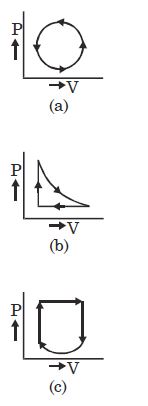
What is the nature of change in internal energy in the following three thermodynamical processes shown in figure
A car when passes through a convex bridge exerts a force on it which is equal to
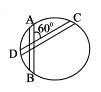
A disc arranged in a vertical plane has two groves of same length directed along the vertical chord $AB$ and $CD$ as shown in the fig. The same particles slide down along $AB$ and $CD$. The ratio of the time $t_{AB}/t_{CD}$ is
A spring balance and a physical balance are kept in a lift. In these balances equal masses are placed. If now the lift starts moving upwards with constant acceleration, then
One mole of an ideal gas at an initial temperature of $T\, K$ does $6\, R\, joules$ of work adiabatically. If the ratio of specific heats of this gas at constant pressure and at constant volume is $\frac{5}{3}$ , the final temperature of gas will be
The amount of work done in blowing a soap bubble such that its diameter increases from $d$ to $D$ is ($T=$ surface tension of the solution)
If the height of a satellite from the earth is negligible in comparison to the radius of the earth $R$, the orbital velocity of the satellite is