MCQ
A beaker is completely filled with water at $4°C$. It will overflow if
  • A
    Heated above $4°C$
  • B
    Cooled below $4°C$
  • Both heated and cooled above and below $4°C$ respectively
  • D
    None of the above

Answer

Correct option: C.
Both heated and cooled above and below $4°C$ respectively
c
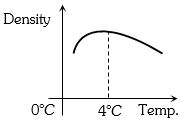
(c) Water has maximum density at $4°C$, so if the water is heated above $4°C$ or cooled below $4°C$ density decreases i.e. volume increases.

In other words, it expands so it overflows in both the cases.
Need a full question paper?

Generate a complete, print-ready paper with questions like this in minutes — across 16+ boards, with answer keys.
Start Generating Free

Similar questions

A body of mass $M$ tied to a string is lowered at a constant acceleration of $(g/4)$ through a vertical distance $h$. The work done by the string will be..............
In a streamline flow:
  1. The speed of a particle always remains same.
  2. The velocity of a particle always remains same.
  3. The kinetic energies of all the particles arriving at a given point are the same.
  4. The momenta of all the particles arriving at a given point are the same.
The collisions of the molecules of an ideal gas are:
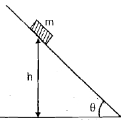
A block of mass $m$ is sliding down an inclined plane with constant speed.At a certain instant $t_0$, its height above the ground is $h$. The coefficient of kinetic friction between the block and the plane is $\mu$. If the block reaches the ground at a later instant $t_g$, then the energy dissipated by friction in the time interval $\left(t_g-t_0\right)$ is
In a cylindrical container open to the atmosphere from the top a liquid is filled upto $10\,\, m$ depth. Density of the liquid varies with depth from the surface as $\rho (h) = 100 + 6h^2$ where $h$ is in meter and $\rho$ is in $kg/m^3.$ The pressure at the bottom of the container will be : $($ atmosphere pressure $= 10^5\,\, Pa, \,g = 10\, m/sec^2)$
Let $T_a$ and $T_b$ be the final temperatures of the samples $A$ and $B$, respectively, in the previous question.
If between wavelength $\lambda $and $\lambda + d\lambda $, ${e_\lambda }$and ${a_\lambda }$ be the emissive and absorptive powers of a body and ${E_\lambda }$ be the emissive power of a perfectly black body, then according to Kirchoff's law, which is true
A wooden piece floats half submerged in a tub of water. If the system is transferred to a lift ascending with acceleration the wooden piece will
An aeroplane of mass $3 \times 10^4\, kg$ and total wing area of $120\, m^2$ is in a level flight at some height. The difference in pressure between the upper and lower surfaces of its wings in kilopascals is $(g=10\,m/s^2)$
In a one-dimensional collision between two particles, their relative velocity is ${\vec v_1}$ before the collision and ${\vec v_2}$ after the collision