MCQ
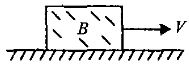
A block $B$ is pushed momentarily along a horizontal surface with an initial velocity $V.$ If $\mu $ is the coefficient of sliding friction between $B$ and the surface, block $B$ will come to rest after a time
  • A
    $\frac{{g{\mu _k}}}{V}$
  • B
    $\;\frac{g}{V}$
  • C
    $\;\frac{V}{g}$
  • $\;\frac{V}{{g{\mu _k}}}$

Answer

Correct option: D.
$\;\frac{V}{{g{\mu _k}}}$
d
Given $u = V$, final velocity $= 0$.
Using $v = u + at$

$\begin{array}{l}
\therefore \,0 = V - at\,\,or,\,\, - a = \frac{{0 - V}}{t} =  - \frac{V}{t}\\
\,\,\,\,f = \mu R = \mu mg\,\left( {f\,is\,the\,force\,of\,friction} \right)\\
\therefore {\rm{Retardation,}}\,{\rm{a}}\,{\rm{ = }}\mu {\rm{g}}\,\therefore {\rm{t}}\, = \frac{V}{a} = \frac{V}{{\mu g}}.
\end{array}$

Need a full question paper?

Generate a complete, print-ready paper with questions like this in minutes — across 16+ boards, with answer keys.

Start Generating Free

Similar questions

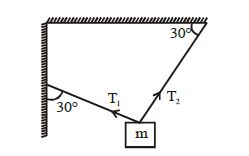
Calculate $T_1$ and $T_2$
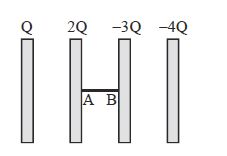
Four very large metal plates are given the charges as shown in figure. The middle two are then connected through a wire. Find the charge that will flow through the wire
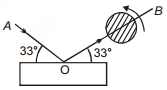
A beam of light $A O$ is incident on a glass slab $(m=1.54)$ in a direction as shown in the diagram. The reflected ray $O B$ is passed through a polariod. On viewing through the polariod, we find that on rotating the polariod $\left(\right.$ Given $\left.\tan 57^{\circ}=1.54\right)$
Two masses ${m_A}$and ${m_B}$moving with velocities ${v_A}$and ${v_B}$in opposite directions collide elastically. After that the masses ${m_A}$and ${m_B}$move with velocity ${v_B}$and ${v_A}$respectively. The ratio $ \frac{m_A}{m_B} =$
Assume there are two identical simple pendulum Clocks$-1$ is placed on the earth and Clock$-2$ is placed on a space station located at a height $h$ above the earth surface. Clock$-1$ and Clock$-2$ operate at time periods $4\,s$ and $6\,s$ respectively. Then the value of $h$ is $....km$ (consider radius of earth $R _{ E }=6400\,km$ and $g$ on earth $10\,m / s ^{2}$ )
A simple pendulum with bob of mass $m$ and length $x$ is held in position at an angle $\theta_1$ and then angle $\theta_2$ with the vertical. When released from these positions, speeds with which it passes the lowest positions are $v_1$ and $v_2$ respectively. Then, $\frac{v_1}{v_2}$ is .............
A uniform solid sphere of mass $m$ is being pulled on a horizontal surface with force $F$ parallel to the surface and applied at its top most point. If the acceleration of the cylinder is $a$ & it is rolling on the surface, the value of $F$ is 
In open organ pipe, if fundamental frequency is $n$ then the other frequencies are
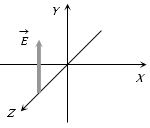
The figure here gives the electric field of an $EM$ wave at a certain point and a certain instant. The wave is transporting energy in the negative $z$ direction. What is the direction of the magnetic field of the wave at that point and instant
Two discs have moments of intertia ${I}_{1}$ and ${I}_{2}$ about their respective axes perpendicular to the plane and passing through the centre. They are rotating with angular speeds, $\omega_{1}$ and $\omega_{2}$ respectively and are brought into contact face to face with their axes of rotation coaxial. The loss in kinetic energy of the system in the process is given by :