MCQ
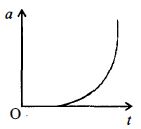
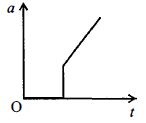
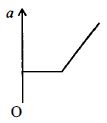
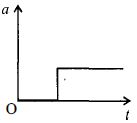
A block is placed on a rough horizontal plane. A time dependent horizontal force $F = kt$ acts on the block, where $k$ is a positive constant. The acceleration - time graph of the block is
  • A


  • C

  • D

Answer

Correct option: B.

b
Graph $(b)$ correctly dipicts the acceleration-time graph of the block

Need a full question paper?

Generate a complete, print-ready paper with questions like this in minutes — across 16+ boards, with answer keys.
Start Generating Free

Similar questions

Supposing Newton's law of gravitation for gravitation forces $F_1$ and $F_2$ between two masses $m_1$ and $m_2$ at positions $r_1$ and $r_2$ read $F_1=-F_2=-\frac{r^{12}}{r_{12}^3} G_0^2\left(\frac{m_1 m_2}{M_0^2}\right)^n$ where $M_0$ is a constant of dimension of mass, $r_{12}=r_1-r_2$ and $n$ is a number. In such a case,
  1. The acceleration due to gravity on earth will be different for different objects.
  2. None of the three laws of Kepler will be valid.
  3. Only the third law will become invalid.
  4. For $n$ negative, an object lighter than water will sink in water.
A sound source is moving towards a stationary observer with $1/10$ of the speed of sound. The ratio of apparent to real frequency is
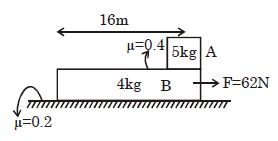
Initially the whole system is at rest and now a force of $62\ N$ is applied on the block $B$ as shown in the figure. Find the time taken by $'A'$ to fall from the block $'B'$ ........... $\sec$
Consider two rods of same length and different specific heats $\left( c _1, c _2\right)$, thermal conductivities $\left( K _1, K_2\right)$ and area of cross-sections $\left(A_1, A_2\right)$ and both having temperatures $\left(T_1, T_2\right)$ at their ends. If their rate of loss of heat due to conduction is equal, then:
In a plane progressive wave given by $y = 25\cos (2\pi t - \pi x)$, the amplitude and frequency are respectively
A mass falls from a helght $h$ and its time of fall $t$ is recorded in terms of time period $T$ of a simple pendulum. On the surface of earth it is found that $t =2 T$. The entre setup is taken on the surface of another planet whose mass is half of that of earth and radius the same. Same experiment is repeated and corresponding times noted as $t'$ and $T'$.
The temperatures of two bodies $A$ and $B$ are ${727^o}C$ and ${127^o}C$. The ratio of rate of emission of radiations will be
The speed of a transverse wave passing through a string of length $50 \;cm$ and mass $10\,g$ is $60\,ms ^{-1}$. The area of cross-section of the wire is $2.0\,mm ^{2}$ and its Young's modulus is $1.2 \times 10^{11}\,Nm ^{-2}$. The extension of the wire over its natural length due to its tension will be $x \times 10^{-5}\; m$. The value of $x$ is $...$
A stone of mass $m$ is tied to a string of length $l$ and rotated in a circle with a constant speed $v$. If the string is released, the stone flies
The two interfering waves have intensities in the ratio $9 : 4$. The ratio of intensities of maxima and minima in the interference pattern will be