MCQ
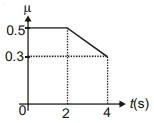
A block is projected with speed $20 \,m / s$ on a rough horizontal surface. The coefficient of friction $(\mu)$ between the surfaces varies with time $(t)$ as shown in figure. The speed of body at the end of $4$ second will be ............ $m / s$ ( $g=$ $10 \,m / s ^2$ )
  • $2$
  • B
    $5$
  • C
    $7.2$
  • D
    $9.5$

Answer

Correct option: A.
$2$
a
(a)

Retardation

$\frac{d v}{d t}=-\mu g$

$\int d v=-\int \mu g d t$

$\Delta v=-g \int \mu d t$

$\int \mu d t$ is area under $\mu-t$ curve

$v-20=-10\left(2 \frac{1}{2}+\frac{1}{2}(2)(0.2)+(2)(0.3)\right)$

$v=20-18=2 \,m / s$

Need a full question paper?

Generate a complete, print-ready paper with questions like this in minutes — across 16+ boards, with answer keys.

Start Generating Free

Similar questions

An incompressible fluid flows steadily through a cylindrical pipe which has radius 2R at point A and Radius R at point B farther along the flow direction. If the velocity at point A is v, its velocity at point B is:
The potential energy of a $1\ kg$ particle free to move along the $x-$axis is given by : $U\left( x \right) = \left( {\frac{{{x^4}}}{4} - \frac{{{x^2}}}{2}} \right)$ $J $ The total mechanical energy of the particle is $2\ J$. Then, the maximum speed(in $m/s$) is
If the ratio of specific heat of a gas at constant pressure to that at constant volume is $\gamma $, the change in internal energy of a mass of gas, when the volume changes from $V$ to $2V$ constant pressure $ p$, is
A car of weight $W$ is on an inclined road that rises by $100\,m$ over a distance of $1\,Km$ and applies a constant frictional force $\frac {W}{20}$ on the car. While moving uphill on the road at a speed of  $10\,ms^{-1},$ the car needs power $P.$  If it needs power $\frac {P}{2}$ while moving down hill at speed $v$ then value of $v$ is ........ $ms^{-1}$
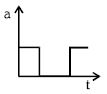
The acceleration-time graph for a body is shown in the graph. Which of the following  graphs would probably represent velocity of the body plotted against time:-
The distance travelled by a particle is related to time $t$ as $x =4 t ^2$. The velocity of the particle at $t =$ $5 s$ is $.........ms^{-1}$
A ball is dropped from the top of a building $100\,m$ high. At the same instant another ball is thrown upwards with a velocity of $40\,m / s$ from the bottom of the building. The two balls will meet after $..........\,s$
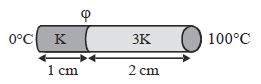
Two bars of thermal conductivities $K$ and $3K$ and lengths $1\,\, cm$ and $2\,\, cm$ respectively have equal cross-sectional area, they are joined lengths wise as shown in the figure. If the temperature at the ends of this composite bar is $0\,^oC$ and $100\,^oC$ respectively (see figure), then the temperature $\varphi $ of the interface is......... $^oC$
One mole of ideal monoatomic gas $(\gamma = 5/3)$ is mixed with one mole of diatomic gas $(\gamma = 7/5).$ What is $\gamma $ for the mixture$?$ $\gamma $ denotes the ratio of specific heat at constant pressure, to that at constant volume
Water rises up to a height $h$ in a capillary tube of certain diameter. This capillary tube is replaced by a similar tube of half the diameter. Now the water will rise to the height of