Question
A block is resting on a piston which is moving vertically with a simple harmonic motion of period 1sec. At what amplitude of motion will the block and the piston seperate? What is the maximum velocity of the piston at this amplitude?

Answer

We know that $\text{y}=\text{a}\sin\omega\text{t}$$\therefore$ Velocity of the block $=\frac{\text{dy}}{\text{dt}}=\text{a}\omega\cos\omega\text{t}$
Acceleration of the block $=\frac{\text{d}^2\text{y}}{\text{dt}^2}=\omega^2\sin\omega\text{t}$
$=-\omega\text{y}$
For maximum acceleration y = a$\therefore\Big(\frac{\text{d}^2\text{y}}{\text{dt}^2}\Big)_\text{max}$
$=-\omega\text{a}$
The block will be separated form the piston when$\omega^2\text{a}=\text{g}$
$=\text{a}=\frac{\text{g}}{\omega}$
$=\Big(\therefore\frac{2\pi}{\text{T}}\Big)$
$=\text{a}=\frac{\text{gT}^2}{4\pi^2}$ According to the given problem T = 1sec.$\therefore\text{a}=\frac{\text{g}}{4\pi^2}$
$=\frac{9.8}{4\times(3.14)^2}$
$=0.248\text{m/ sec}^2$
At this amplitude, the maximum velocity of the block will be$\omega\text{a}=\frac{2\pi}{\text{T}}$
$\frac{2\times3.14\times.0.248}{1}$
$=1.56\text{m/ sec}$

Need a full question paper?

Generate a complete, print-ready paper with questions like this in minutes — across 16+ boards, with answer keys.
Start Generating Free

Similar questions

It is found that yellow light does not eject photoelectrons from a metal. Is it advisable to try with orange light? With green light?
A cricketer can throw a ball to a maximum horizontal distance of 100m. How much high above the ground can the cricketer throw the same ball.
Two blocks of masses $400g$ and $200g$ are connected through a light string going over a pulley which is free to rotate about its axis. The pulley has a moment of inertia $1.6 \times 10^{-4}kg-m^2$ and a radius $2.0cm$. Find:
  1. The kinetic energy of the system as the $400g$ block falls through $50cm$.
  2. The speed of the blocks at this instant.
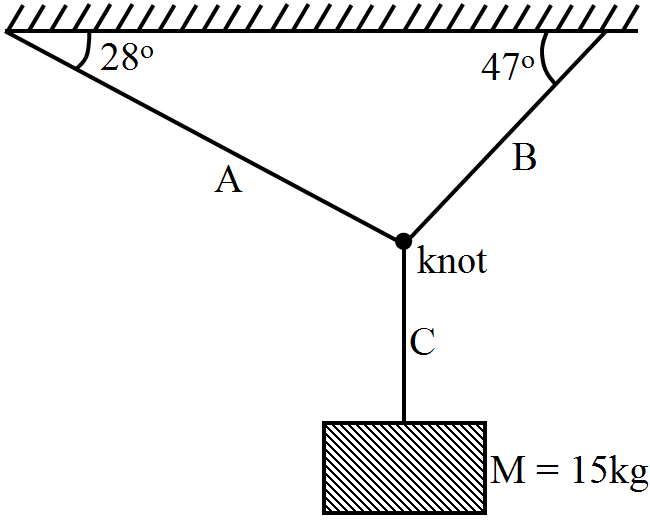
A block of mass $15kg$ hangs from three chords as shown in figure. What are the tensions in the chords?
The motion of a particle executing simple harmonic motion is described by the displacement function,$\text{x(t)}=\text{A}\cos(\omega\text{t}+\phi).$
If the initial (t = 0) position of the particle is 1cm and its initial velocity is $\omega\text{ cm/s,}$ what are its amplitude and initial phase angle? The angular frequency of the particle is $\pi\text{s}^{-1}.$ If instead of the cosine function, we choose the sine function to describe the SHM: $\text{x}=\text{B}\sin(\omega\text{t}+\alpha),$ what are the amplitude and initial phase of the particle with the above initial conditions.
An 8kg body performs S.H.M. of amplitude 30cm. The restoring force is 60N when the displacement is 30cm. Find (a) time period (b) the acceleration, P.E. and K.E., when displacement is 12cm.
A block whose mass is $1kg$ is fastened to a spring. The spring has a spring constant of $50Nm^{-1}$. The block is pulled to a distance $x = 10cm$ from the equilibrium position at $x = 0$ on a frictionless surface from rest at $t = 0$. Calculate the kinetic, potential and total energies of the block when it is $5cm$ away from the mean position.
A non-viscous liquid of constant density $1000 \mathrm{~kg} \mathrm{~m}^{-3}$ flows in a streamline motion along a tube of variable crosssection. The tube is a kept inclined in the vertical plane as shown in figure. The area of cross-section of the tube at two points $P$ and $Q$ at heights of 2 m and 5 m are respectively, $4 \times 10^{-3} \mathrm{~m}^2$ and $8 \times 10^{-3} \mathrm{~m}^2$. The velocity of the liquid at point $P$ is $1 \mathrm{~m} \mathrm{~s}^{-1}$. Find the work done per unit volume by the pressure and the gravity forces as the fluid flows from point $P$ to $Q$.
In an experiment with Foucault's apparatus, the various distances used are as follows:
Distance between the rotating and the fixed mirror = 16m
Distance between the lens and the rotating mirror = 6m
Distance between the source and the lens = 2m
When the mirror is rotated at a speed of 356 revolutions per second, the image shifts by 0.7mm. Calculate the speed of light from these data.
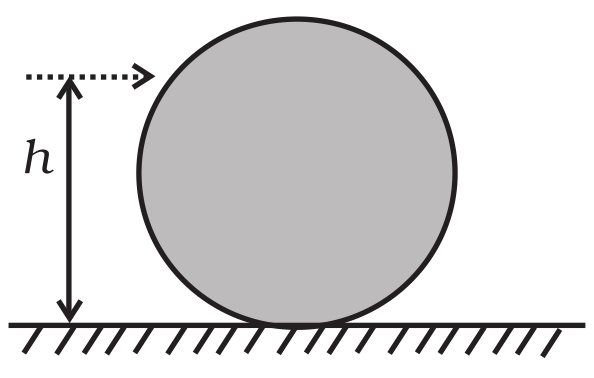
A uniform sphere of mass m and radius R is placed on a rough horizontal surface. The sphere is struck horizontally at a height h from the floor. Match the following:
a. $\text{h}=\frac{\text{R}}{2}$ i. Sphere rolls without slipping with a constant velocity and no loss of energy.
b. $\text{h}=\text{R}$ ii. Sphere spins clockwise, loses energy by friction.
c. $\text{h}=\frac{3\text{R}}{2}$ iii. Sphere spins anti-clockwise, loses energy by friction.
d. $\text{h}=\frac{7\text{R}}{5}$ iv. Sphere has only a translational motion, looses energy by friction.