Question
A block of mass M is pulled along a horizontal surface by applying a force at an angle with horizontal. Coefficient of friction between block and surface is u. If the block travels with uniform velocity, find the work done by this applied force during ú displacement d of the block.
Answer

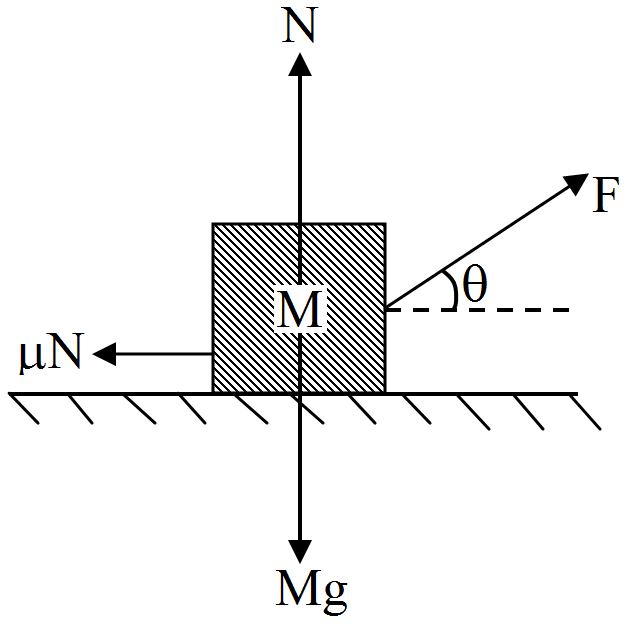
The forces acting on the block are shown in Figure. As the block moves with uniform velocity the forces add up to zero.

$\therefore\text{F}\cos\theta=\mu\text{N}\cdots\text{(i)}$

$\text{F}\sin\theta+\text{N}=\text{mg}\cdots\text{(ii)}$

Eliminating N from equation (i) and (ii),

$\text{F}\cos\theta=\mu(\text{Mg}-\text{F}\sin\theta)$

$\text{F}=\frac{\mu\text{Mg}}{\cos\theta+\mu\sin\theta}$

Work done by this force during a displacement d

$\text{W}=\text{F}.\text{d}\cos\theta=\frac{\mu\text{Mgd}\cos\theta}{\cos\theta+\mu\sin\theta}$

Need a full question paper?

Generate a complete, print-ready paper with questions like this in minutes — across 16+ boards, with answer keys.

Start Generating Free

Similar questions

Water is filled in a rectangular tank of size 3m × 2m × 1m.
  1. Find the total force exerted by the water on the bottom surface of the tank.
  2. Consider a vertical side of area 2m × 1m. Take a horizontal strip of width ox metre in this side, situated at a depth of x metre from the surface of water. Find the force by the water on this strip.
  3. Find the torque of the force calculated in part.(b) about the bottom edge of this side.
  4. Find the total force by the water on this side.
  5. Find the total torque by the water on the side about.
The bottom edge. Neglect the atmospheric pressure and take g = 10m/s2.
The volume of a liquid flowing out per second of a pipe of length l and radius r is written by a student as,
$\text{v}=\frac{\pi}{8}\frac{\text{Pr}^4}{\eta\text{l}}$
where P is the pressure difference between the two ends of the pipe and $\eta$ is coefficent of viscosity of the liquid having dimensional formula ML-1 T-1.
Check whether the equation is dimensionally correct.
Calculate the Q-value of the fusion reaction
4He + 4He = 8Be.
Is such a fusion energetically favourable? Atomic mass of 8Be is 8.0053u and that of 4He is 4.0026u.
A 0.2kg. of mass hangs at the end of a spring. When 0.02kg more mass is added to the end of the spring, it stretches 7cm more. If the 0.02kg mass is removed, what will be the period of vibration of the system?
For a particle in S.H.M., the displacement x of the particle as a function of time t is given as $\text{x = A}\sin(2\pi\text{t}).$ Here x is in cm and t is in seconds.
Let the time taken by the particle to travel from x = 0 to $\text{x}=\frac{\text{A}}{2}$ be T1 and the time taken to travel from $\text{x}=\frac{\text{A}}{2}$ to x = A be T2. Find $\frac{\text{T}_1}{\text{T}_2}.$
A man has to go 50m due north, 40m due east and 20m due south to reach a field.
  1. What distance he has to walk to reach the field?
  2. What is his displacement from his house to the field?
It is a common observation that rain clouds can be at about a kilometre altitude above the ground.
If a rain drop falls from such a height freely under gravity, what will be its speed? Also calculate in km/h. (g = 10m/s2)
A rod of length L is placed along the X-axis between x = 0 and x = L. The linear density (mass/ length) $\rho$ of the rod varies with the distance x from the origin as $\rho=\text{a + bx.}$
  1. Find the SI units of a and b.
  2. Find the mass of the rod in terms of a, b and L.
The minute hand of a wall clock is 10cm long. Find its displacement and the distance covered from 12:00 noon to 12:30 p.m.
What is the nature of sound waves in air? How is the speed of sound waves in atmosphere affected by the:
  1. Humidity.
  2. Temperature?