MCQ
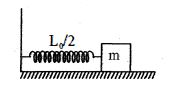
A block of mass $m$ is pushed against a spring whose spring constant is $k$ fixed at one end with a wall. The block can slide on a frictionless table as shown in figure. If the natural length of spring is $L_0$ and it is compressed to half its length when the block is released, find the velocity of the block, when the spring has natural length
  • A
    $\sqrt {\frac{m}{k}} .\frac{{{L_0}}}{2}$
  • $\sqrt {\frac{k}{m}} .\frac{{{L_0}}}{2}$
  • C
    $\sqrt {\frac{k}{m}} .{L_0}$
  • D
    $\sqrt {\frac{{k{L_0}}}{m}} $

Answer

Correct option: B.
$\sqrt {\frac{k}{m}} .\frac{{{L_0}}}{2}$
b
The energy stored in the spring when it is compressed to $\frac{\mathrm{L}_{0}}{2}$ is converted into kinetic energy of the block

$\frac{1}{2} m u^{2}=\frac{1}{2} k\left(\frac{L_{0}}{2}\right)^{2}$

Need a full question paper?

Generate a complete, print-ready paper with questions like this in minutes — across 16+ boards, with answer keys.

Start Generating Free

Similar questions

A wave is represented by $x=4 \cos \left(8 t-\frac{y}{2}\right)$, where $x$ and $y$ are in metre and $t$ in second. The frequency of the wave $\left(\right.$ in $^{-1}$ ) is .........
A particle is thrown vertically upwards with a velocity of $4\,ms^{-1}$. The ratio of its accelerations after $1\,s$ and $2\,s$ of its motion is
A particle is projected from ground in vertical upward direction at $t = 0$, with initial velocity $48\, m/s$ and the distance travelled by particle in $5^{th}$ second is......$m$ $(g = 10\, m/s^2)$
Suppose you have taken a dilute solution of oleic acid in such a way that its concentration becomes $0.01 \,cm ^{3}$ of oleic acid per $cm ^{3}$ of the solution. Then you make a thin film of this solution (monomolecular thickness) of area $4\, cm ^{2}$ by considering $100$ spherical drops of radius $\left(\frac{3}{40 \pi}\right)^{\frac{1}{3}} \times 10^{-3}\, cm .$ Then the thickness of oleic acid layer will be $x \times 10^{-14} \,m$. Where $x$ is ...... .
Two bodies have same mass and speed, then:
A particle is moving with constant speed $v$ in $x y$ plane as shown in figure. The magnitude of its angular velocity about point $O$ is .........
A closed organ pipe and an open pipe of same length produce $4$ beats when they are set into vibrations simultaneously. If the length of each of them were twice their initial lengths, the number of beats produced will be
List-$I$ List-$II$
$(a)$ $MI$ of the rod (length ${L}$, Mass ${M}$, about an axis $\perp$ to the rod passing through the midpoint) $(i)\;\frac {8 {ML}^{2}}{3}$
$(b)$ MI of the rod (length $L$, Mass $2 M$, about an axis $\perp$ to the rod Passing through one its end) $(ii)\;\frac {{ML}^{2}}{3}$
$(c)$ MI of the rod (length $2 {L}$, Mass ${M}$, about an axis $\perp$ to the rod  Passing through its midpoint) $(iii)\;\frac {{ML}^{2}}{12}$
$(d)$ MI of the rod (length $2 {L}$, Mass $2 {M}$, about an axis $\perp$ to the rod  passing through one of its end) $(iv)\;\frac {2 {ML}^{2}}{3}$

 Choose the correct answer from the options given below

The persistence of sound in a room after the source of sound is turned off is called reverberation. The measure of reverberation time is the time required for sound intensity to decrease by $60 \,dB$. It is given that the intensity of sound falls off as $I_0 \exp \left(-c_1 \alpha\right)$ where $I_0$ is the initial intensity, $c_1$ is a dimensionless constant with value $1 / 4$. Here, $\alpha$ is a positive constant which depends on the speed of sound, volume of the room, reverberation time, and the effective absorbing area $A_e$. The value of $A_e$ is the product of absorbing coefficient (with value between $0$ and $1,1$ being a perfect absorber) and the area of the room. For a concert hall of volume $600 \,m ^3$, the value of $A_e$ (in $m ^2$ ) required to give a reverberation time of $1 s$ is closest to (speed of sound in air $=340 \,m / s$ )
The reactance of a circuit is zero. It is possible that the circuit contains:
  1. An inductor and a capacitor.
  2. An inductor but no capacitor.
  3. A capacitor but no inductor.
  4. Neither an inductor nor a capacitor.