Question
A block of mass m moving with speed v compresses a spring through a distance x before its speed is halved. What is the value of spring constant?

Answer

Initial Kinetic energy $=\frac{1}{2}\text{m}\upsilon_2$
Final Energy $=\frac{1}{2}\text{m}\Big(\frac{\text{v}}{2}\Big)^2+\frac{1}{2}\text{kx}^2$
BY the principle of conservation of wenergy,
$\frac{1}{2}\text{m}\upsilon^2=\frac{1}{2}\frac{\text{m}\upsilon^2}{4}+\frac{1}{2}\text{kx}^2$
$\therefore\text{K}=\frac{3\text{m}\upsilon^2}{4\text{x}^2}$.

Need a full question paper?

Generate a complete, print-ready paper with questions like this in minutes — across 16+ boards, with answer keys.

Start Generating Free

Similar questions

What is a fixed volume thermometer? Explain its principle. How is it better than a mercury thermometer?
Particles of masses 1g, 2g, 3g, ........, 100g are kept at the marks 1cm, 2cm, 3cm, ........, 100cm respectively on a metre scale. Find the moment of inertia of the system of particles about a perpendicular bisector of the metre scale.
A famous relation in physics relates ‘moving mass’ m to the ‘rest mass’ mo of a particle in terms of its speed v and the speed of light, c. (This relation first arose as a consequence of special relativity due to Albert Einstein). A boy recalls the relation almost correctly but forgets where to put the constant c. He writes:

$\text{m}=\frac{\text{m}_0}{(1-\text{v}^2)^{1/2}}.$

Guess where to put the missing c.
A ball of mass m moving at a speed v makes a head-on collision with an identical ball at rest. The kinetic energy of the balls after the collision is three fourths of the original. Find the coefficient of restitution.
Hydrogen gas is contained in a closed vessel at 1atm (100kPa) and 300K. (a) Calculate the mean speed of the molecules. (b) Suppose the molecules strike the wall with this speed making an average angle of 45° with it. How many molecules strike each square metre of the wall per second?
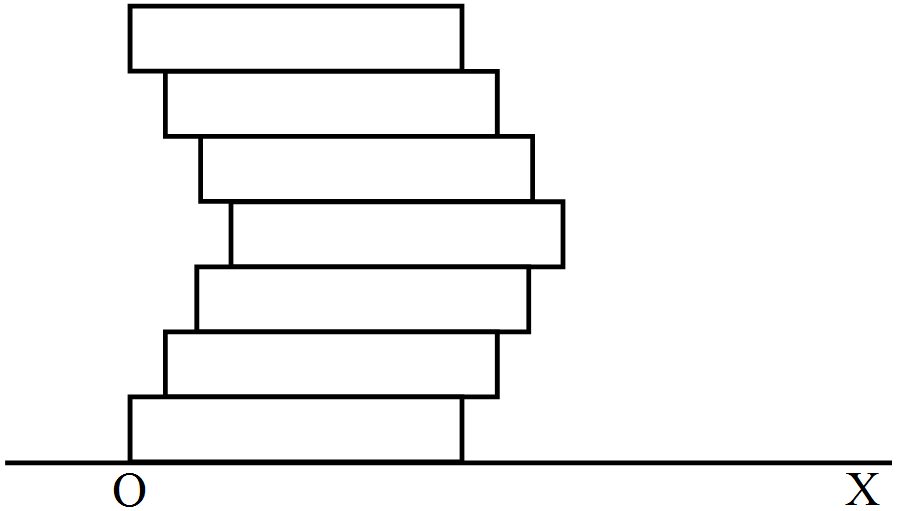
Seven homogeneous bricks, each of length L, are arranged as shown in figure. Each brick is displaced with respect to the one in contact by $\frac{\text{L}}{10}.$ Find the x-coordinate of the centre of mass relative to the origin shown.

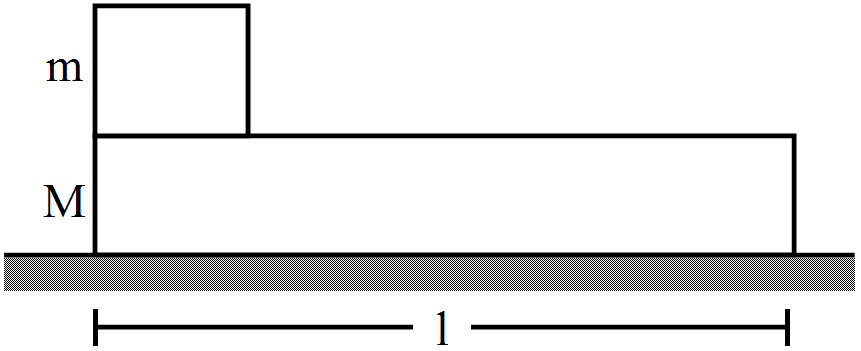
Figure shows a small block of mass m kept at the left end of a larger block of mass M and length l. The system can slide on a horizontal road. The system is started towards right with an initial velocity v. The friction coefficient between the road and the bigger block is g and that between the block is $\frac{\mu}{2}.$ Find the time elapsed before the smaller blocks separates from the bigger block.

A cube of aluminium of each side 4cm is subjected to a tangential (shearing) force. The top face of the cube is sheared through 0.012cm with respect to the bottom face.
Find:
  1. Shearing strain,
  2. Shearing stress;
  3. The shearing force.
Given: $\eta=2008\times10^{11}\text{dyne},\text{cm}^{-2}.$
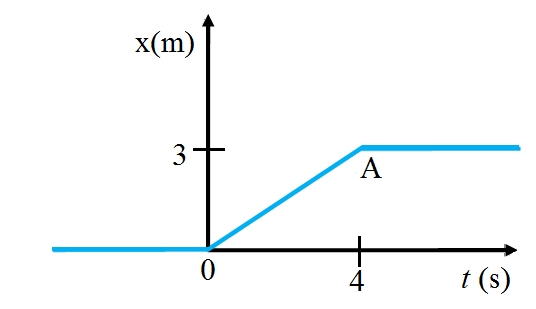
Figure. shows the position-time graph of a particle of mass 4kg. What is the (a) force on the particle for t < 0, t > 4s, 0 < t < 4s? (b) impulse at t = 0 and t = 4s? (Consider one-dimensional motion only).

A force $3\hat{\text{i}}+2\hat{\text{j}}$ displaces a 1kg mass from $\hat{\text{i}}+\hat{\text{j}}$  to $-\hat{\text{i}}+2\hat{\text{j}}$. Find the work done.