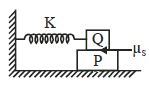
A block $P$ of mass $m$ is placed on a smooth horizontal surface. A block $Q$ of same mass is placed over the block $P$ and the coefficient of static friction between them is ${\mu _S}$. A spring of spring constant $K$ is attached to block $Q$. The blocks are displaced together to a distance $A$ and released. The upper block oscillates without slipping over the lower block. The maximum frictional force between the block is
Diffcult


Download our appand get started for free
Experience the future of education. Simply download our apps or reach out to us for more information. Let's shape the future of learning together!No signup needed.*
Similar Questions
- 1A particle with restoring force proportional to displacement and resisting force proportional to velocity is subjected to a force $F\sin \omega t$. If the amplitude of the particle is maximum for $\omega = {\omega _1}$ and the energy of the particle is maximum for $\omega = {\omega _2}$, then (where ${\omega _0}$ natural frequency of oscillation of particle)View Solution
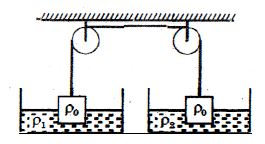
- 2Consider two identical cylinders [each of mass $m$ density $\rho _0$ horizontal cross-section area $s$] in equilibrium, partially submerged in two containers filled with liquids of densities $\rho_1$ and $\rho_2$ as shown in figure. Find the period of small oscillations of this system about its equilibrium. Neglect the changes in the level of liquids in the containers. Neglect mass of the strings. acceleration due to gravity is $g$ . ($v$ is volume of each block)View Solution
- 3A particle executing simple harmonic motion has an amplitude of $6\, cm$. Its acceleration at a distance of $2 \,cm$ from the mean position is $8\,cm/{s^2}$. The maximum speed of the particle is ... $ cm/s$View Solution
- 4A particle executes simple harmonic motion (amplitude $= A$) between $x = - A$ and $x = + A$. The time taken for it to go from $0$ to $A/2$ is ${T_1}$ and to go from $A/2$ to $A$ is ${T_2}$. ThenView Solution
- 5The resultant of two rectangular simple harmonic motions of the same frequency and equal amplitudes but differing in phase by $\frac{\pi }{2}$ isView Solution
- 6$Assertion :$ In $SHM$, acceleration is always directed towards the mean position.View Solution
$Reason :$ In $SHM$, the body has to stop momentary at the extreme position and move back to mean position. - 7The displacement of a particle executing periodic motion is given by :View Solution
$y = 4cos^2\,(t/2)sin\,(1000t)$
This expression may be considered to be a result of superposition of - 8The displacement equations of two interfering waves are given byView Solution
$y_1 =10 \sin \left(\omega t+\frac{\pi}{3}\right) cm$
$y_2 =5[\sin (\omega t)+\sqrt{3} \cos \omega t] \;cm$ respectively.
The amplitude of the resultant wave is $.............cm$.
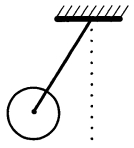
- 9A metal rod of length ' $L$ ' and mass ' $m$ ' is pivoted at one end. A thin disk of mass ' $M$ ' and radius $'R'$ $( < L)$ is attached at its center to the free end of the rod. Consider two ways the disc is attached: (case $A$) The disc is not free to rotate about its center and (case $B$) the disc is free to rotate about its center. The rod-disc system performs $SHM$ in vertical plane after being released from the same displaced position. Which of the following statement$(s)$ is (are) true? $Image$View Solution
$(A)$ Restoring torque in case $A =$ Restoring torque in case $B$
$(B)$ Restoring torque in case $A < $ Restoring torque in case $B$
$(C)$ Angular frequency for case $A > $ Angular frequency for case $B$.
$(D)$ Angular frequency for case $A < $ Angular frequency for case $B$.
- 10View SolutionThe period of a simple pendulum is doubled, when