MCQ
A block slides down a smooth inclined plane when released from the top, while another falls freely from the same point
  • A
    sliding block will reach the ground first with greater speed
  • B
    freely falling block will reach the ground first with greater speed
  • C
    both the blocks will reach the ground at the same time but with different speeds
  • both the blocks will reach the ground with same speed but the freely falling block first

Answer

Correct option: D.
both the blocks will reach the ground with same speed but the freely falling block first
d
In case of sliding motion on an inclined plane,

${\mathrm{h}=\mathrm{s}=\frac{1}{2} \mathrm{g} \sin \theta \mathrm{t}^{2}}$

${\text { or } \mathrm{t}=\mathrm{t_s}=\frac{1}{\sin \theta} \sqrt{\frac{2 \mathrm{h}}{\mathrm{g}}}}$

${\text { and } \mathrm{u}_{\mathrm{s}}=\sqrt{2 \mathrm{gh}}=\sqrt{2(\mathrm{g} \sin \theta) \mathrm{s}}}$

while in case of free fall,

$\mathrm{t}_{\mathrm{F}}=\sqrt{\frac{2 \mathrm{h}}{\mathrm{g}}}$ and $\mathrm{u}_{\mathrm{F}}=\sqrt{2 \mathrm{gh}}$

$\frac{\mathrm{t}_{\mathrm{F}}}{\mathrm{t}_{\mathrm{s}}}=\sin \theta<1 \mathrm{i.e.}, \mathrm{t}_{\mathrm{F}}<\mathrm{t}_{\mathrm{s}}$

i.e., falling body reaches the ground first.

Also $\quad \frac{\mathrm{u}_{\mathrm{F}}}{\mathrm{u}_{\mathrm{s}}}=1,$ i.e., $\mathrm{u}_{\mathrm{F}}=\mathrm{u}_{\mathrm{s}}$

i.e., both reach the ground with same speed (not velocity as for falling body direction is vertical while for sliding body along the plane downwards).
Need a full question paper?

Generate a complete, print-ready paper with questions like this in minutes — across 16+ boards, with answer keys.

Start Generating Free

Similar questions

What is the value of linear velocity, if $\vec \omega = 3\hat i - 4\hat j + \hat k$ and $\vec r = 5\hat i - 6\hat j + 6\hat k$
In $1913,$ Niels Bohr gave theory on the basis of:
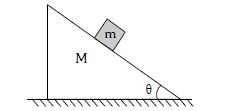
A block of mass $m$ slides down on a wedge of mass $M$ as shown in figure. Let $\vec a_1$ be the acceleration of the wedge and $\vec a_2$  the acceleration of block w.r.t. ground. $N_1$ is the normal reaction between block and wedge and $N_2$ the normal reaction between wedge and ground. Friction is absent everywhere. Select the incorrect alternative
For a periodic motion represented by the equation $Y=\sin \omega t+\cos \omega t$ The amplitude of the motion is 
The Mean Free Path $\ell$ for a gas molecule depends upon diameter, $d$ of the molecule as
A vibratory motion is represented by $x = 2\,A\,\cos \,\omega t + A\,\cos \,\left( {\omega t + \frac{\pi }{2}} \right) + A\,\cos \,\left( {\omega t + \pi } \right) + \frac{A}{2}\,\cos \,\left( {\omega t + \frac{{3\pi }}{2}} \right)$ The resultant amplitude of motion is
A motorist starting a car from rest accelerates uniformly to a speed of $v\, m/s$ in $9\, seconds$. He maintains this speed for another $50\, seconds$ and then applies the brakes and decelerates uniformly to rest. His deceleration is numberically equal to three times his previous acceleration. Then the time during which the deceleration takes place is ..........$s$ :-
Two planets $A$ and $B$ have the same material density. If the radius of $A$ is twice that of $B,$ then the ratio of the escape velocity $\frac{V_A}{V_B}$ is
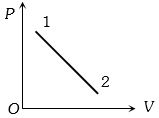
A volume $V$ and pressure $P$ diagram was obtained from state $1$ to state $2$ when a given mass of a gas is subjected to temperature changes. During this process the gas is
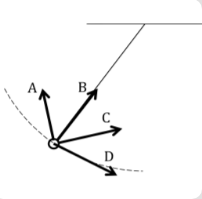
A mass attached to a string that is itself attached to the ceiling swings back and forth. If the bob is observed to be moving upward at a given instance, as shown to the right, which arrow best depicts the direction of the net force acting on the bob at that instant: