MCQ
A block slides down a smooth inclined plane when released from the top, while another falls freely from the same point
  • A
    sliding block will reach the ground first with greater speed
  • B
    freely falling block will reach the ground first with greater speed
  • C
    both the blocks will reach the ground at the same time but with different speeds
  • both the blocks will reach the ground with same speed but the freely falling block first

Answer

Correct option: D.
both the blocks will reach the ground with same speed but the freely falling block first
d
In case of sliding motion on an inclined plane,

${\mathrm{h}=\mathrm{s}=\frac{1}{2} \mathrm{g} \sin \theta \mathrm{t}^{2}}$

${\text { or } \mathrm{t}=\mathrm{t_s}=\frac{1}{\sin \theta} \sqrt{\frac{2 \mathrm{h}}{\mathrm{g}}}}$

${\text { and } \mathrm{u}_{\mathrm{s}}=\sqrt{2 \mathrm{gh}}=\sqrt{2(\mathrm{g} \sin \theta) \mathrm{s}}}$

while in case of free fall,

$\mathrm{t}_{\mathrm{F}}=\sqrt{\frac{2 \mathrm{h}}{\mathrm{g}}}$ and $\mathrm{u}_{\mathrm{F}}=\sqrt{2 \mathrm{gh}}$

$\frac{\mathrm{t}_{\mathrm{F}}}{\mathrm{t}_{\mathrm{s}}}=\sin \theta<1 \mathrm{i.e.}, \mathrm{t}_{\mathrm{F}}<\mathrm{t}_{\mathrm{s}}$

i.e., falling body reaches the ground first.

Also $\quad \frac{\mathrm{u}_{\mathrm{F}}}{\mathrm{u}_{\mathrm{s}}}=1,$ i.e., $\mathrm{u}_{\mathrm{F}}=\mathrm{u}_{\mathrm{s}}$

i.e., both reach the ground with same speed (not velocity as for falling body direction is vertical while for sliding body along the plane downwards).
Need a full question paper?

Generate a complete, print-ready paper with questions like this in minutes — across 16+ boards, with answer keys.

Start Generating Free

Similar questions

The motion of a simple pendulum excuting $S.H.M$. is represented by following equation.

$Y = A \sin (\pi t +\phi)$, where time is measured in $second$.

The length of pendulum is .............$cm$

A constant force acts on a body. Which of the following correctly represents the variation of the power $P$ developed with time $t$?
Susceptibility of ferromagnetic substance is
Let $[{\varepsilon _0}]$ denotes the dimensional formula of the permittivity of the vacuum and $[{\mu _0}]$ that of the permeability of the vacuum. If $M = {\rm{mass}}$, $L = {\rm{length}}$, $T = {\rm{Time}}$ and $I = {\rm{electric current}}$, then
A uniform rope of mass $1.0\, kg$ is connected with a box of mass $2.0\, kg$, which is placed on a smooth horizontal surface. The free end of the rope is pulled horizontally by a force $6\, N$. Find the tension at the midpoint of the rope ....... $N$
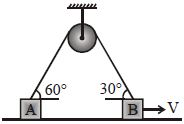
For the given diagram when block $B$ is pulled with velocity $V$ then velocity of block $A$ will be :-
The temperature of an open room of volume $30\ m^3$ increases from $17^o C$ to $27vC$ due to sunshine. The atmospheric pressure in the room remains $1 \times 10^5\ Pa$. Ifni and nr are the number of molecules in the room before and after heating, then $n_f-n_i$ will be :
A short electric dipole has a dipole moment of $16 \times 10^{-9}\, Cm .$ The electric potential due to the dipole at a point at a distance of $0.6\, m$ from the centre of the dipole, situated on a line making an angle of $60^{\circ}$ with the dipole axis is $.........V$

$\left(\frac{1}{4 \pi \epsilon_{0}}=9 \times 10^{9} Nm ^{2} / C ^{2}\right)$

The time period of a vibration magnetometer is $T_0$. Its magnet is replaced by another magnet whose moment of inertia is $3$ times and magnetic moment is $1/3$ of the initial magnet. The time period now will be
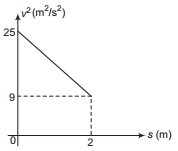
A graph between the square of the velocity of a particle and the distance $s$ moved by the particle is shown in the figure. The acceleration of the particle is $...........m/s^2$