MCQ
A body $A$ moves with a uniform acceleration $a$ and zero initial velocity. Another body $B$, starts from the same point moves in the same direction with a constant velocity $v$. The two bodies meet after a time $t$. The value of $t$ is
  • $\frac{{2v}}{a}$
  • B
    $\frac{v}{a}$
  • C
    $\frac{v}{{2a}}$
  • D
    $\sqrt {\frac{v}{{2a}}} $

Answer

Correct option: A.
$\frac{{2v}}{a}$
a
(a)$\frac{1}{2}a{t^2} = vt \Rightarrow t = \frac{{2v}}{a}$

Need a full question paper?

Generate a complete, print-ready paper with questions like this in minutes — across 16+ boards, with answer keys.

Start Generating Free

Similar questions

A body performs $S.H.M.$ Its kinetic energy $K$ varies with time $t$ as indicated by graph
The expression $\left( {\frac{1}{{\sqrt 2 }}\hat i + \frac{1}{{\sqrt 2 }}\hat j} \right)$ is a
A transverse wave travels along the Z-axis. The particles of the medium must move:
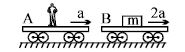
Two trolley $A$ and $B$ are moving with accelerations $a$ and $2a$ respectively in the same direction. To an observer in trolley $A$ , the magnitude of pseudo force acting on a block of mass $m$ on the trolley $B$ is
A $140\,g$ ball, in horizontal flight with a speed of $39.0\,m/s$, is struck by a bat. After leaving the bat, the ball travels in the opposite direction with speed $39.0\,m/s$. If the impact time $\Delta t$ for the ball-bat collision is $1.20\,ms$, ............ $N$ average force acts on the ball .
A Carnot engine has efficiency $25\%$ . It operates between reservoirs of constant temperature with temperature difference of $80\,K$ . What is the temperature of low temperature reservoir ...... $^oC$
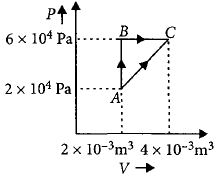
Figure below shows two paths that may be taken by a gas to go from a state $A$ to a state $C.$ In process $AB,$ $400 \,J$ of heat is added to the system and in process $BC,$ $100\, J$ of heat is added to the system. The heat absorbed by the system in the process $AC$ will be ...... $J$
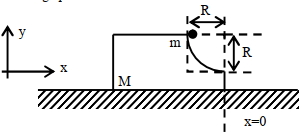
A block of mass $M$ has a circular cut with a frictionless surface as shown. The block rests on the horizontal frictionless surface of a fixed table. Initially the right edge of the block is at $x=0$, in a co-ordinate system fixed to the table. A point mass $m$ is released from rest at the topmost point of the path as shown and it slides down. When the mass loses contact with the block, its position is $\mathrm{x}$ and the velocity is $\mathrm{v}$. At that instant, which of the following options is/are correct?

(image)

$[A]$ The $x$ component of displacement of the center of mass of the block $M$ is : $-\frac{m R}{M+m}$.

[$B$] The position of the point mass is : $x=-\sqrt{2} \frac{\mathrm{mR}}{\mathrm{M}+\mathrm{m}}$.

[$C$] The velocity of the point mass $m$ is : $v=\sqrt{\frac{2 g R}{1+\frac{m}{M}}}$.

[$D$] The velocity of the block $M$ is: $V=-\frac{m}{M} \sqrt{2 g R}$.

Let Q and W denote the amount of heat given to an ideal gas and the work done by it in an isothermal process.
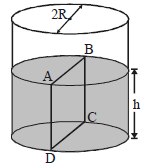
Water is filled up to a height $h$ in a beaker of radius $R$ as shown in the figure. The density of water is $\rho$, the surface tension of water is $T$ and the atmospheric pressure is $P_0$. Consider a vertical section $ABCD$ of the water column through a diameter of the beaker. The force on water on one side of this section by water on the other side of this section has magnitude