MCQ
A body executing simple harmonic motion has a maximum acceleration equal to $ 24\,metres/se{c^2} $ and maximum velocity equal to $ 16\;metres/sec $. The amplitude of the simple harmonic motion is
  • $\frac{{32}}{3}\,metres$
  • B
    $\frac{3}{{32}}\,metres$
  • C
    $\frac{{1024}}{9}\,metres$
  • D
    $\frac{{64}}{9}\,metres$

Answer

Correct option: A.
$\frac{{32}}{3}\,metres$
a
(a) Maximum velocity $ = a\omega = 16$ 

Maximum acceleration $ = {\omega ^2}a = 24$ 

$ \Rightarrow a = \frac{{{{(a\omega )}^2}}}{{{\omega ^2}a}} = \frac{{16 \times 16}}{{24}} = \frac{{32}}{3}m$

Need a full question paper?

Generate a complete, print-ready paper with questions like this in minutes — across 16+ boards, with answer keys.

Start Generating Free

Similar questions

An $AC$ source producing emf $\in=\in_{0}\Big[\cos\big(100\pi\text{s}^{-1}\big)\text{t}+\cos\big(500\pi\text{s}^{-1}\big)\text{t}\Big]$ is connected in series with a capacitor and a resistor. The steady$-$state current in the circuit is found to be $\text{i}=\text{i}_1\cos\Big[\big(100\pi\text{s}^{-1}\big)\text{t}+\phi_1\Big]+\text{i}_2\cos\Big[\big(500\pi\text{s}^{-1}\big)\text{t}+\phi_2\Big].$
The r.m.s. velocity of a gas at a certain temperature is $\sqrt 2 $ times than that of the oxygen molecules at that temperature. The gas can be
A bucket full of water is revolved in vertical circle of radius $2\,m$. What should be the maximum time-period of revolution so that the water doesn't fall off the bucket ......... $\sec$.
Mark the correct statements about the friction between two bodies:
Consider the motion of the tip of the minute hand of a clock. In one hour:
An elevator accelerates upwards at a constant rate. A uniform string of length $L$ and mass $m$ supports a small block of mass $M$ that hangs from the ceiling of the elevator. The tension at distance $l$ from the ceiling is $T$ . The acceleration of the elevator is
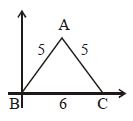
A thin uniform wire is bent to form the two equal sides $AB$ and $AC$ of triangle $ABC$, where $AB = AC = 5\,cm.$ The third side $BC$, of length $6\,cm,$ is made from  uniform wire of twice the density of the first. The distance of centre of mass from $A$ is
The ratio of the dimension of Planck's constant and that of moment of inertia is the dimension of
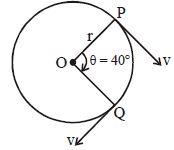
A particle is moving on a circular path of radius $r$ with uniform speed $v$. The magnitude of change in velocity when the particle moves from $P$ to $Q$ is  $(\angle POQ = 40^o)$
Three bodies $A, B$ and $C$ of masses $m, m$ and $\sqrt 3\,m$ respectively are supplied heat at a constant rate. The change in temperature $\theta $ versus time $t$ graph for $A, B$ and $C$ are shown by $I, II$ and $III$ respectively. If their specific heat capacities are $S_A, S_B$ and $S_C$ respectively then which of the following relation is correct ? (Initial temperature of body is $0\,^oC$ )