MCQ
A body is executing Simple Harmonic Motion. At a displacement $x$ its potential energy is ${E_1}$ and at a displacement y its potential energy is ${E_2}$. The potential energy $E$ at displacement $(x + y)$ is
  • A
    $\sqrt E = \sqrt {{E_1}} - \sqrt {{E_2}} $
  • $\sqrt E = \sqrt {{E_1}} + \sqrt {{E_2}} $
  • C
    $E = {E_1} - {E_2}$
  • D
    $E = {E_1} + {E_2}$

Answer

Correct option: B.
$\sqrt E = \sqrt {{E_1}} + \sqrt {{E_2}} $
b
(b) ${E_1} = \frac{1}{2}K{x^2}$

$\Rightarrow x = \sqrt {\frac{{2{E_1}}}{K}} $, 

${E_2} = \frac{1}{2}K{y^2}$

$\Rightarrow y = \sqrt {\frac{{2{E_2}}}{K}} $ and 

$E = \frac{1}{2}K{(x + y)^2} $

$\Rightarrow x + y = \sqrt {\frac{{2E}}{K}} $ 

$ \Rightarrow \sqrt {\frac{{2{E_1}}}{K}} + \sqrt {\frac{{2{E_2}}}{K}} = \sqrt {\frac{{2E}}{K}} $

$ \Rightarrow \sqrt {{E_1}} + \sqrt {{E_2}} = \sqrt E $

Need a full question paper?

Generate a complete, print-ready paper with questions like this in minutes — across 16+ boards, with answer keys.

Start Generating Free

Similar questions

Two men are carrying a uniform bar of length $L$, on their shoulders. The bar is held horizontally such that younger man gets $(1/4)^{th}$ load. Suppose the younger man is at the end of the bar, what is the distance of the other man from the end
The specific heat of hydrogen gas at constant pressure is ${C_P} = 3.4 \times {10^3}cal/kg{\,^o}C$ and at constant volume is ${C_V} = 2.4 \times {10^3}cal/kg{\,^o}C.$If one kilogram hydrogen gas is heated from ${10^o}C$ to ${20^o}C$ at constant pressure, the external work done on the gas to maintain it at constant pressure is
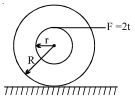
$A$ time varying force $F = 2t$ is applied on a spool rolling as shown in figure. The angular momentum of the spool at time $t$ about bottommost point is:
$A$ ball strikes a smooth horizontal ground at an angle of $45^o$ with the vertical. What cannot be the possible angle of its velocity with the vertical after the collision ................. $^o$ (Assume $e \leq 1$ ).
We have half a bucket $(6l)$ of water at $20\,^oC$  . If we want water at $40\,^oC$, how much steam at $100\,^oC$ should be added to it ?
A body is moving with constant speed, in a circle of radius $10 m$. The body completes one revolution in $4 s$. At the end of $3 rd$ second, the displacement of body (in $m$ ) from its starting point is:
Using dimensional analysis, the resistivity in terms of fundamental constants $h, m_{e}, c, e, \varepsilon_{0}$ can be expressed as
For the four sets of three measured physical quantities as given below. Which of the following options is correct ?

$(i)$ $\mathrm{A}_{1}=24.36, \mathrm{B}_{1}=0.0724, \mathrm{C}_{1}=256.2$

$(ii)$ $\mathrm{A}_{2}=24.44, \mathrm{B}_{2}=16.082, \mathrm{C}_{2}=240.2$

$(iii)$ $\mathrm{A}_{3}=25.2, \mathrm{B}_{3}=19.2812, \mathrm{C}_{3}=236.183$

$(iv)$ $\mathrm{A}_{4}=25, \mathrm{B}_{4}=236.191, \mathrm{C}_{4}=19.5$

The power of a pump, which can pump $500 \,kg$ of water to height $100 \,m$ in $10 \,s$ is .......... $kW$
A jet lands on an aircraft carrier at 30 m/s. It stops in 2.0 s. What is the displacement of the plane when it stops?