MCQ
A body is moving in a circular path with a constant speed. It has
  • A
    A constant velocity
  • B
    A constant acceleration
  • An acceleration of constant magnitude
  • D
    An acceleration which varies with time

Answer

Correct option: C.
An acceleration of constant magnitude
(c) Centripetal acceleration $=\frac{v^2}{r}=$ constant. Direction keeps changing.

Need a full question paper?

Generate a complete, print-ready paper with questions like this in minutes — across 16+ boards, with answer keys.
Start Generating Free

Similar questions

If $|\vec{A} \times \vec{B}|=\sqrt{3} \vec{A} \cdot \vec{B}$, then the value of $|\vec{A}+\vec{B}|$ is
A body takes 4 minutes to cool from $100^{\circ} \mathrm{C}$ to $70^{\circ} \mathrm{C}$. To cool from $70^{\circ} \mathrm{C}$ to $40^{\circ} \mathrm{C}$ it will take (room temperature is $15^{\circ} \mathrm{C}$ )
Water rises upto a height $h$ in a capillary on the surface of earth in stationary condition. Value of $h$ increases if this tube is taken
In a coil of area $10 \mathrm{~cm}^2$ and $10$ turns with a magnetic field directed perpendicular to the plane and is changing at the rate of $10^8$ gauss/second. The resistance of the coil is $20 \mathrm{ohm}$. The current in the coil will be
In order to coincide the parabolas formed by singly ionised ions in one spectrograph and doubly ionized ions in the other Thomson's mass spectrograph, the electric fields and magnetic fields are kept in the ratios $1: 2$ and $3: 2$ respectively. Then the ratio of masses of the ions is
The current flowing in two coaxial coils in the same direction. On increasing the distance between the two, the electric current will
The number of dry cells, each of e.m.f. $1.5$ volt and internal resistance $0.5 \mathrm{ohm}$ that must be joined in series with a resistance of $20 \mathrm{ohm}$ so as to send a current of $0.6$ ampere through the circuit is
The direction of line of magnetic field of bar magnet is
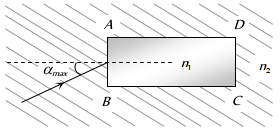
A rectangular glass slab $A B C D$, of refractive index $n$, is immersed in water of refractive index $n(n>n)$. A ray of light in incident at the surface $A B$ of the slab as shown. The maximum value of the angle of incidence $\alpha_{-}$, such that the ray comes out only from the other surface $C D$ is given by
Image
The slopes of isothermal and adiabatic curves are related as