MCQ
A body is started from rest with acceleration $2\ m/ s^2$ till it attains the maximum velocity then retards to rest with $3\ m/ s^2$. If total time taken is $10$ second then maximum speed attained is:
  • $12\ m/ s$
  • B
    $8\ m/ s$
  • C
    $6\ $m/ s$
  • D
    $4\ m/ s$

Answer

Correct option: A.
$12\ m/ s$
$a. \ 12\ m/ s$

Need a full question paper?

Generate a complete, print-ready paper with questions like this in minutes — across 16+ boards, with answer keys.

Start Generating Free

Similar questions

A bomb of $12 \,kg$ explodes into two pieces of masses $4 \,kg $ and $8 \,kg$. The velocity of $8\,kg$  mass is $6 m/sec$. The kinetic energy of the other mass is ............. $\mathrm{J}$
A particle moving with a uniform acceleration travels $24$ metre and $64$ metre in first two consecutive intervals of $4$ seconds each. Its initial velocity is:
Choose the fundamental forces from the options given below:
Three blocks $A$, $B$ and $C$ are pulled on a horizontal smooth surface by a force of $80 \mathrm{~N}$ as shown in figure

The tensions $T_1$ and $T_2$ in the string are respectively

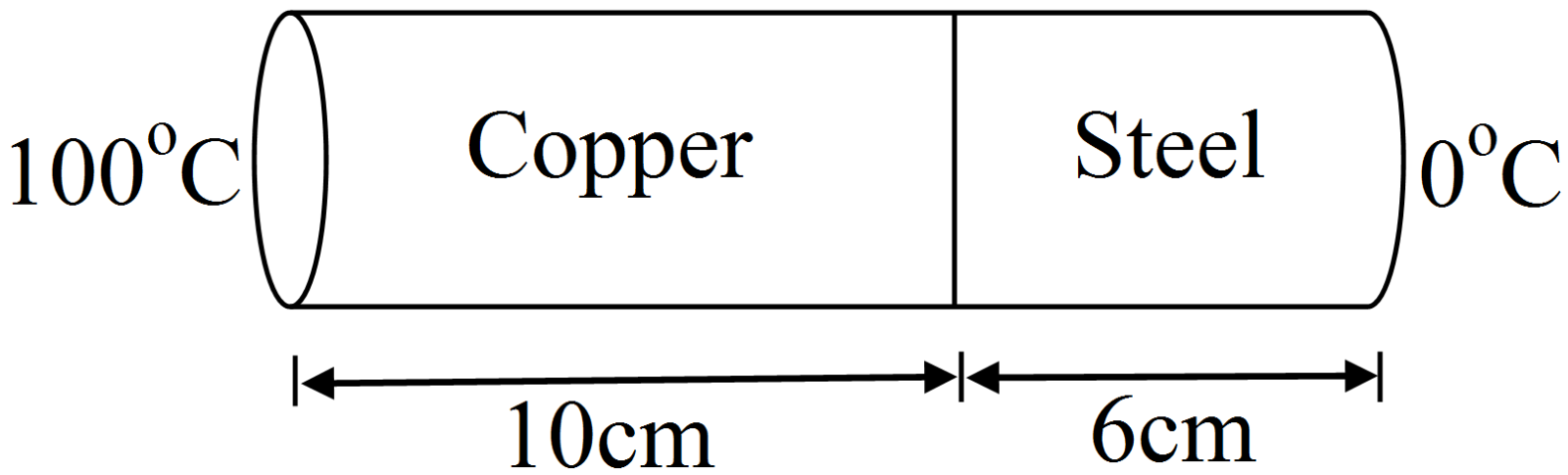
The coefficient of thermal conductivity of copper is nine times that of steel. In the composite cylindrical bar shown in fig. What will be the temperature at the junction of copper and steel?
A constant force is acting perpendicular to the velocity of a particle. For this situation which one is correct?
If the resultant of all the external forces acting on a system of particles is zero, then from an inertial frame, one can surely say that
$250\,gm$ of water and an equal volume of alcohol of mass $200\,gm$ are placed successively in the same calorimeter and cools from $60^{\circ}\,C$ to $55^{\circ}\,C$ in $130\,sec$ and $67 sec$ respectively. If the water equivalent of the calorimeter is $10\,gm$. , then the specific heat of alcohol in cal/gm $cal / gm ^{\circ}\,C$ is
An ideal gas follows a process described by the equation $PV ^2= C$ from the initial $\left( P _1, V _1, T _1\right)$ to final $\left(P_2, V_2, T_2\right)$ thermodynamics states, where $C$ is a constant. Then
Consider the motion of the tip of the minute hand of a clock. In one hour: