A body is vibrating in simple harmonic motion with an amplitude of $0.06\, m$ and frequency of $15\, Hz$. The velocity and acceleration of body is
Medium
Download our app for free and get started
(a)Velocity $v = a\omega = a \times 2\pi \;n$
$ = 0.06 \times 2\pi \times 15 = 5.65\;m/s$
Acceleration $A = {\omega ^2}a = 4{\pi ^2}{n^2}a = 5.32 \times {10^2}m/{s^2}$
$ = 0.06 \times 2\pi \times 15 = 5.65\;m/s$
Acceleration $A = {\omega ^2}a = 4{\pi ^2}{n^2}a = 5.32 \times {10^2}m/{s^2}$

Download our appand get started for free
Experience the future of education. Simply download our apps or reach out to us for more information. Let's shape the future of learning together!No signup needed.*
Similar Questions
- 1When a mass $m$ is attached to a spring, it normally extends by $0.2\, m$. The mass $m$ is given a slight addition extension and released, then its time period will beView Solution
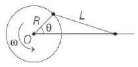
- 2One end of a rod of length $L$ is fixed to a point on the circumference of a wheel of radius $R$. The other end is sliding freely along a straight channel passing through the centre of the wheel as shown in the figure below. The wheel is rotating with a constant angular velocity $\omega$ about $O$. Taking $T=\frac{2 \pi}{\omega}$, the motion of the rod isView Solution
- 3If the length of simple pendulum is increased by $300\%$, then the time period will be increased by ..... $\%$View Solution
- 4View SolutionIdentify correct statement among the following
- 5A clock $S$ is based on oscillations of a spring and a clock $P$ is based on pendulum motion. Both clocks run at the same rate on earth. On a planet having same density as earth but twice the radius thenView Solution
- 6A block is placed on a frictionless horizontal table. The mass of the block is m and springs are attached on either side with force constants ${K_1}$ and ${K_2}$. If the block is displaced a little and left to oscillate, then the angular frequency of oscillation will beView Solution
- 7A body of mass $5\; kg$ hangs from a spring and oscillates with a time period of $2\pi $ seconds. If the ball is removed, the length of the spring will decrease byView Solution
- 8Starting from the mean position a body oscillates simple harmonically with a period of $2\,s.$ After what time will its kinetic energy be $75\%$ of the total energy ?View Solution
- 9A particle of mass $1\, {kg}$ is hanging from a spring of force constant $100\, {Nm}^{-1 .}$ The mass is pulled slightly downward and released so that it executes free simple harmonic motion with time period ${T}$. The time when the kinetic energy and potential energy of the system will become equal, is $\frac{{T}}{{x}}$. The value of ${x}$ is ..... .View Solution
- 10View SolutionA system exhibiting S.H.M. must possess