A body is vibrating in simple harmonic motion with an amplitude of $0.06\, m$ and frequency of $15\, Hz$. The velocity and acceleration of body is
Medium


Download our appand get started for free
Experience the future of education. Simply download our apps or reach out to us for more information. Let's shape the future of learning together!No signup needed.*
Similar Questions
- 1A particle executing simple harmonic motion with amplitude of $0.1 \,m$. At a certain instant when its displacement is $0.02 \,m$, its acceleration is $0.5 \,m/s^2$. The maximum velocity of the particle is (in $m/s$)View Solution
- 2A uniform disc of mass $M$ and radius $R$ is suspended in vertical plane from a point on its periphery. Its time period of oscillation is ........View Solution
- 3Acceleration of a particle, executing $SHM$, at it’s mean position isView Solution
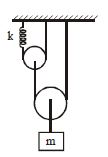
- 4What is the period of small oscillations of the block of mass $m$ if the springs are ideal and pulleys are massless ?View Solution
- 5For a simple pendulum, a graph is plotted between its kinetic energy $(KE)$ and potential energy $(PE)$ against its displacement $d$. Which one of the following represents these correctly? (graphs are schematic and not drawn to scale)View Solution
- 6If particle is executing simple harmonic motion with time period $T$, then the time period of its total mechanical energy is ...........View Solution
- 7When a body of mass $1.0\, kg$ is suspended from a certain light spring hanging vertically, its length increases by $5\, cm$. By suspending $2.0\, kg$ block to the spring and if the block is pulled through $10\, cm$ and released the maximum velocity in it in $m/s$ is : (Acceleration due to gravity $ = 10\,m/{s^2})$View Solution
- 8Time period of a particle executing $SHM$ is $8\, sec.$ At $t = 0$ it is at the mean position. The ratio of the distance covered by the particle in the $1^{st}$ second to the $2^{nd}$ second is :View Solution
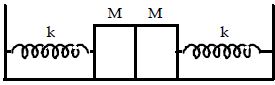
- 9View SolutionAn assembly of identical spring-mass systems is placed on a smooth horizontal surface as shown. Initially the springs are relaxed. The left mass is displaced to the left while the right mass is displaced to the right and released. The resulting collision is elastic. The time period of the oscillations of the system is :-
- 10A particle is executing simple harmonic motion $(SHM)$ of amplitude $A,$ along the $x-$ axis, about $x = 0.$ When its potential energy $(PE)$ equals kinetic energy $(KE),$ the position of the particle will beView Solution