Question
A body rotating at 20rad/s is acted upon by a constant torque providing it a deceleration of 2rad/s2. At what time will the body have kinetic energy same as the initial value if the torque continues to act?

Answer

Initial angular velocity = 20rad/s

Therefore $\alpha=2\text{rad/s}^2$

$\Rightarrow\text{t}_1=\frac{\omega_2}{\alpha_1}=\frac{20}{2}=10\text{sec}$

Therefore 10sec it will come to rest.

Since the same torque is continues to act on the body it will produce same angular acceleration and since the initial kinetic energy = the kinetic energy at a instant.

So initial angular velocity = angular velocity at that instant

Therefore time require to come to that angular velocity,

$\Rightarrow\text{t}_2=\frac{\omega}{\alpha_2}=\frac{20}{2}=10\text{sec}$

therefore time required = t1 + t2 = 20sec.

Need a full question paper?

Generate a complete, print-ready paper with questions like this in minutes — across 16+ boards, with answer keys.
Start Generating Free

Similar questions

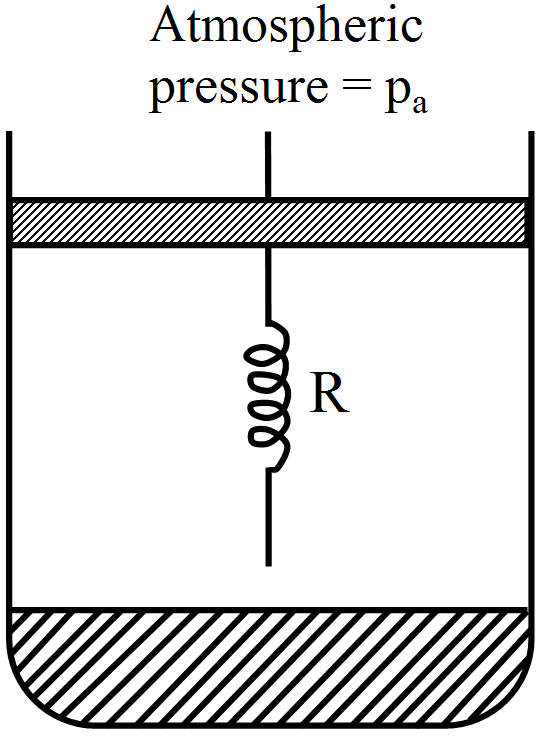
Consider one mole of perfect gas in a cylinder of unit cross-section with a piston attached (figure). A spring (spring constant k) is attached (unstretched length L) to the piston and to the bottom of the cylinder. Initially, the spring is unstretched and the gas is in equilibrium.
A certain amount of heat Q is supplied to the gas causing an increase of volume from V0 to V1.
  1. What is the initial pressure of the system?
  2. What is the final pressure of the system?
  3. Using the first law of thermodynamics, write down a relation between Q, Pa, V, V0, and k.
​​​​​​​
The length of a metal wire is lwhen the tension in it is T1 and is I2 when the tension is T2. Find the original length of the wire.
A metre stick is balanced on a knife edge at its centre. When two coins, each of mass 5 g are put one on top of the other at the 12.0 cm mark, the stick is found to be balanced at 45.0 cm. What is the mass of the metre stick?
Two equal charges are placed at a separation of 1.0m. What should be the magnitude of the charges so that the force between them equals the weight of a 50kg person?
Briefly discuss subtraction of vectors.
In Searle's experiment, the diameter of the wire as measured by a screw guage of least count 0.001cm is 0.500cm. The length, measured by a scale of least count 0.1cm is 110.0cm. When a weight of 40N is suspended from the wire, its extension is measured to be 0.125cm by a micrometer of least count 0.001cm. Find the Young's modulus of the material of the wire from this data.
Two exactly similar rain drops falling with terminal velocity of $(2)^{\frac13}\text{ms}^{-1}$ coalesce to form a bigger drop. Find the terminal velocity of the bigger drop.
The conductivity of a pure semiconductor is roughly proportional to $\text{T}^\frac{3}{2}\text{e}^{\frac{-\Delta\text{E}}{2\text{kT}}}$ where $\Delta\text{E}$ is the band gap. The band gap for germanium is 0.74eV at 4K and 0.67eV at 300K. By what factor does the conductivity of pure germanium increase as the temperature is raised from 4K to 300K?
Two particles have equal masses of 5.0g each and opposite charges of +4.0 × 10-5 C and -4.0 × 10-5C. They are released from rest with a separation of 1.0m between them. Find the speeds of the particles when the separation is reduced to 50cm.
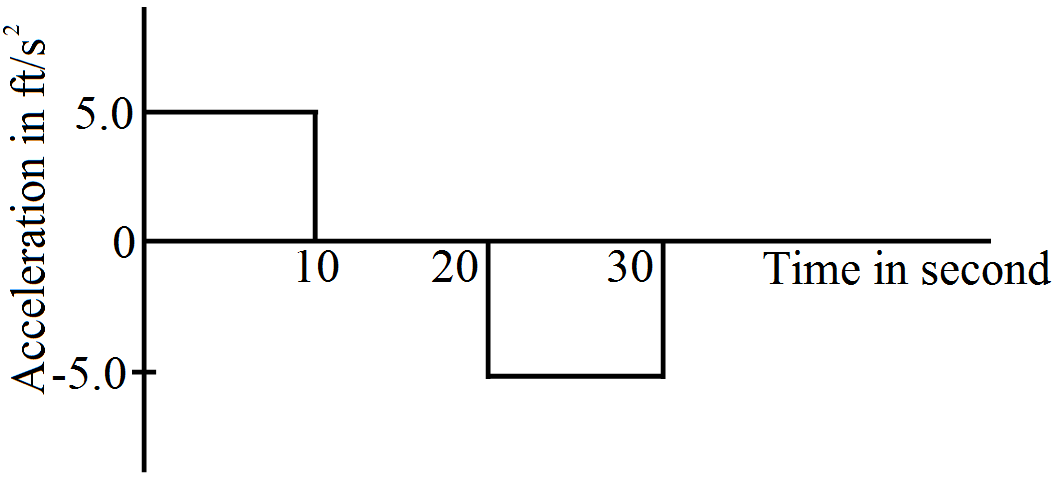
The acceleration of a cart started at t = 0, varies with time as shown in figure. Find the distance travelled in 30 seconds and draw the position-time graph.