Question

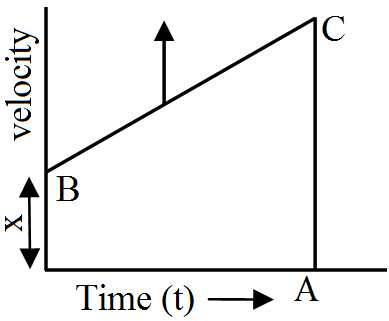
A body with an initial velocity x moves with a uniform acceleration y. Plot its velocity-time graph.
Answer

We have to plot a graph between velocity and time. From the graph we can conclude that the curve is a straight line showing uniform acceleration.


Need a full question paper?

Generate a complete, print-ready paper with questions like this in minutes — across 16+ boards, with answer keys.

Start Generating Free

Similar questions

What are cnidoblasts?
Alka was making tea in a kettle. Suddenly she felt intense heat from the puff of steam gushing out of the spout of the kettle. She wondered whether the temperature of the steam was higher than that of the water boiling in the kettle. Comment.
In a given sample of ammonia, $9g$ hydrogen and $42\ g$ nitrogen are present. In another sample, $5\ g$ hydrogen is present along with nitrogen. Calculate the amount of nitrogen in the second sample.
Name the process associated with the following: A drop of ink placed on the surface of water contained in a glass spreads throughout the water.
An object of mass $40kg$ is raised to a height of 5m above the ground. What is its potential energy$?$ If the object is allowed to fall, find its kinetic energy when it is half-way down.
Calculate the momentum of the following:
  1. An elephant of mass $2000\ kg$ moving at $5\ m/s.$
  2. A bullet of mass $0.02\ kg$ moving at $400\ m/s.$

What can you say about the motion of an object if its speed - 'time graph is a straight line parallel to the time axis?
Two bodies having equal masses are moving with uniform speeds of $v$ and $2v$ respectively. Find the ratio of their kinetic energies.
In an experiment to measure his power, a student records the time taken by him in running in a flight of steps on a staircase. Use the following data to calculate the power of the student: Number of steps $=28$ Height of each step $= 20 cm$ Time taken $=5.4 s$ Mass of student $=55 kg$ Acceleration $=9.8 ms^{-2}$ Due to gravity.
A stone of $1 \ kg$ is thrown with a velocity of $20\ ms^{-1}$ across the frozen surface of a lake and comes to rest after travelling a distance of $50 m$. What is the force of friction between the stone and the ice?