MCQ
A body with mass $5\ kg$ is acted upon by a force $\text{F}=(-3\hat{\text{i}}+4\hat{\text{j}})\text{N.}$ If its initial velocity at $t = 0$ is $\text{v}=(6\hat{\text{i}}-12\hat{\text{j}})\text{m s}^{-1},$ the time at which it will just have a velocity along the $y-$axis is:
  • A
    never
  • $10s$
  • C
    $2s$
  • D
    $15s$

Answer

Correct option: B.
$10s$
According to the problam, mass $m = 5\ kg$
Force which is acting uppon the block $\vec{\text{F}}=(-3\hat{\text{i}}+4\hat{\text{j}})\text{N}$
Inital velocity at $\text{t}=0,\ \vec{\text{u}}=(6\vec{\text{i}}-12\vec{\text{j}})\text{m/s}$
Retardation, $\vec{\text{a}}=\frac{\vec{\text{F}}}{\text{m}}=\Big(-\frac{3\vec{\text{i}}}{5}+\frac{4\vec{\text{j}}}{5}\Big)\text{m/s}^2$
And when final veocity is along $y-$axis only, its $x-$componet must be zero.
We have to apply kinematic wquations seprately for $x-$component only. then we get $\text{v}_\text{x}=\text{u}_\text{x}+\text{a}_\text{x}\text{t}$
$0= 6\vec{\text{i}}-\frac{3\vec{\text{i}}}{5}\text{t}$
$\text{t}=\frac{5\times6}{3}=10\ \text{s}$

Need a full question paper?

Generate a complete, print-ready paper with questions like this in minutes — across 16+ boards, with answer keys.

Start Generating Free

Similar questions

An earthquake generates both transverse $(S)$ and longitudinal $(P)$ sound waves in the earth. The speed of $S$ waves is about $4.5 \,km/s$ and that of $P$ waves is about $8.0 \,km/s.$ A seismograph records $P$ and $S$ waves from an earthquake. The first $P$ wave arrives $4.0\, min$ before the first $S$ wave. The epicenter of the earthquake is located at a distance about .... $km$
If $250 \,J$ of work is done in sliding a $5 \,kg$ block up an inclined plane of height $4 \,m$. value of Work done against friction is ............. $J$ $\left(g=10 \,ms ^{-2}\right)$
Choose the correct alternatives:
  1. For a general rotational motion, angular momentum $L$ and angular velocity $\omega$ need not be parallel.
  2. For a rotational motion about a fixed axis, angular momentum $L \omega$ are always parallel.
  3. For a general translational motion, momentum $P$ and velocity $v$ are aways parallel.
  4. For a general translational motion, acceleration $a$ and velocity $v$ are always parallel.
The amplitude of a wave represented by displacement equation

$y = \frac{1}{{\sqrt a }}\,\sin \,\omega t \pm \frac{1}{{\sqrt b }}\,\cos \,\omega t$ will be

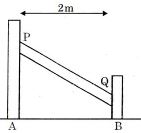
Two vertical walls are separated by a distance of $2\  m$. Wall $A$ is smooth while wall $B$ is rough with a coefficient of friction $0. 5$. A uniform rod is placed between them as shown. The length of longest rod that can be placed between walls is equal to
In the expansion of a gas in the adiabatic process:
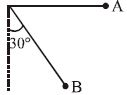
A simple pendulum is released from $A$ as shown in figure. If $m$ and $l$ represent the mass of the bob and the length of the pendulum respectively, the gain in kinetic energy at $B$ is
A motorcycle is going on an overbridge of radius $R$. The driver maintains a constant speed. As the motorcycle is ascending on the overbridge, the normal force on it
Under elastic limit the stress is 
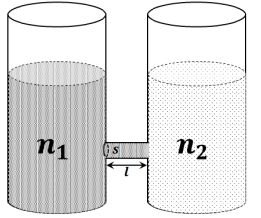
As shown schematically in the figure, two vessels contain water solutions (at temperature $T$ ) of potassium permanganate $\left( KMnO _4\right)$ of different concentrations $n_1$ and $n_2\left(n_1>n_2\right)$ molecules per unit volume with $\Delta n=\left(n_1-n_2\right) \ll n_1$. When they are connected by a tube of small length $\ell$ and cross-sectional area $S , KMnO _4$ starts to diffuse from the left to the right vessel through the tube. Consider the collection of molecules to behave as dilute ideal gases and the difference in their partial pressure in the two vessels causing the diffusion. The speed $v$ of the molecules is limited by the viscous force $-\beta v$ on each molecule, where $\beta$ is a constant. Neglecting all terms of the order $(\Delta n)^2$, which of the following is/are correct? ( $k_B$ is the Boltzmann constant)-

$(A)$ the force causing the molecules to move across the tube is $\Delta n k_B T S$

$(B)$ force balance implies $n_1 \beta v \ell=\Delta n k_B T$

$(C)$ total number of molecules going across the tube per sec is $\left(\frac{\Delta n}{\ell}\right)\left(\frac{k_B T}{\beta}\right) S$

$(D)$ rate of molecules getting transferred through the tube does not change with time