MCQ
A bomb is projected with $200\,m/s$ at an angle $60^o$ with horizontal. At the highest  point, it explodes into three particles of equal masses. One goes vertically upward with  velocity $100\,m/sec$, second particle goes vertically downward with the same velocity as  the first. Then what is the velocity of the third one-
  • A
    $120\, m/sec$ with $60^o$ angle
  • B
    $200 \,m/sec$ with $30^o$ angle
  • C
    $50\, m/sec$, in horizontal direction
  • $300\, m/sec$, in horizontal direction
Answer

Correct option: D.
$300\, m/sec$, in horizontal direction
d
By $COLM$ in $Hz$ $dir^n$

$\mathrm{m}(100)=\frac{\mathrm{m}}{3} \mathrm{v}^{\prime}$

$\mathrm{V}^{\prime}=300 \mathrm{m} / \mathrm{sin} \mathrm{Hz} \mathrm{dir}^{\mathrm{n}}$

Need a full question paper?

Generate a complete, print-ready paper with questions like this in minutes — across 16+ boards, with answer keys.

Start Generating Free

Similar questions

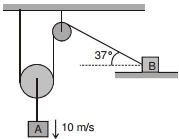
Find velocity of block ' $B$ ' at the instant shown in figure $........\,m/s$
One mole of a perfect gas in a cylinder fitted with a piston has a pressure $P,$ volume $V$ and temperature $T.$ If the temperature is increased by $1 \,K$ keeping pressure constant, the increase in volume is
A point moves in $x-y$ plane as per $x=kt,$ $y = kt\left( {1 - \alpha t} \right)$ where $k\,\& \,\alpha \,$ are $+ve$ constants. The equation of trajectory is 
Infrared radiation is detected by
$Assertion :$ Melting of solid causes no change in internal energy.
$Reason :$ Latent heat is the heat required to melt a unit mass of solid.
The angle of contact between glass and water is $0^o$ and it rises in a capillary upto $6$ cm when its surface tension is $70$ dynes/cm. Another liquid of surface tension $140\, dynes/cm$, angle of contact $60^o$ and relative density $2$ will rise in the same capillary by ........ $cm$
Consider following statements

$(A)$ Any physical quantity have more than one unit

$(B)$ Any physical quantity have only one dimensional formula

$(C)$ More than one physical quantities may have same dimension

$(D)$ We can add and subtract only those expression having same dimension

Number of correct statement is

An object is projected in the air with initial velocity $u$ at an angle $\theta$. The projectile motion is such that the horizontal range $R$, is maximum. Another object is projected in the air with a horizontal range half of the range of first object. The initial velocity remains same in both the case. The value of the angle of projection, at which the second object is projected, will be $.......$ degree.
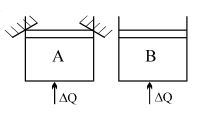
Two identical vessels $A \& B$ contain equal amount of ideal monoatomic gas. The piston of $A$ is fixed but that of $B$ is free. Same amount of heat is absorbed by$A \& B$. If $B'$s internal energy increases by $100 \,\,J$ the change in internal energy of $A$ is ...... .$J$
The velocity at the maximum height of a projectile is half of its initial velocity $u$. Its range on the horizontal plane is