Question
A capacitor has capacitance C. Is this information sufficient to know what maximum charge the capacitor can contain? If yes, what is this charges? If no, what other information is needed?

Answer

No, This information is not sufficient. Since the charge is proportional to the potential difference across the capacitor, we need to know the potential difference applied across the capacitor.
$\text{q}\propto\text{V}$
$\Rightarrow\text{q}=\text{CV}$
Here, q is the charge, V is the potential difference applied and C is the proportionality constant, i.e. capacitance.

Need a full question paper?

Generate a complete, print-ready paper with questions like this in minutes — across 16+ boards, with answer keys.
Start Generating Free

Similar questions

On joining resistances in parallel, the total resistance of the circuit will increase or decrease?
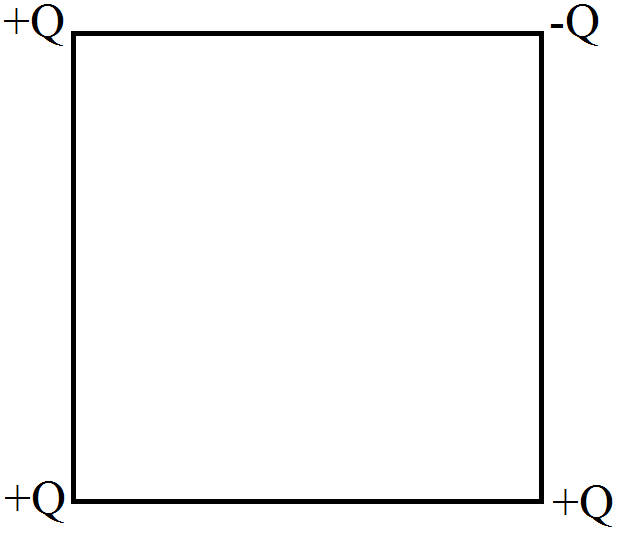
Show diagrammatically the arrangement of four point electric charges of equal magnitude placed at four corners of a square such that the electric field as well as the electric potential at the centre of the square is non-zero.
A sample of $\text{HCI}$ gas is placed in an electric field of $2.5 \times 10^4NC^{-1}$ The dipole moment of each $\text{HCI}$ molecule is $3.4 \times 10^{-30}\ Cm$ Find the maximum torque that can act on a molecule.
A magician during a show makes a glass lens with $n=1.47$ disappear in a trough of liquid. What is the refractive index of the liquid? Could the liquid be water?
Define the term relaxation time' in a conductor.
In the phenomenon of interference, write the value of path difference of superimposed waves at the places where constructive and destructive interference occurs.
Two blocks $A$ and $B$ of mass $m_A$ and $m_B$ respectively are kept in contact on a frictionless table. The experimenter pushes the block $A$ from behind so that the blocks accelerate. If the block $A$ exerts a force $F$ on the block $B,$ what is the force exerted by the experimenter on $A$?
Is the dispersion power of crown glass more or less than that of flint glass? Write.
Two parallel wires are located very close to each other. The upper wire is fixed and the lower is free. What should be direction of current of suitable magnitude in both wires to stop the free wire? Give reason also.
A capacitor has been charged by a dc source. What are the magnitudes of conduction and displacement currents, when it is fully charged?