Question
A capacitor is connected to an alternating-current source. Is there a magnetic field between the plates?

Answer

When an alternating-current source is connected to a capacitor, the electric field between the plates of the capacitor keeps on changing with the applied voltage. Due to the changing electric field, a magnetic field exists in between the plates of the capacitor.

Need a full question paper?

Generate a complete, print-ready paper with questions like this in minutes — across 16+ boards, with answer keys.
Start Generating Free

Similar questions

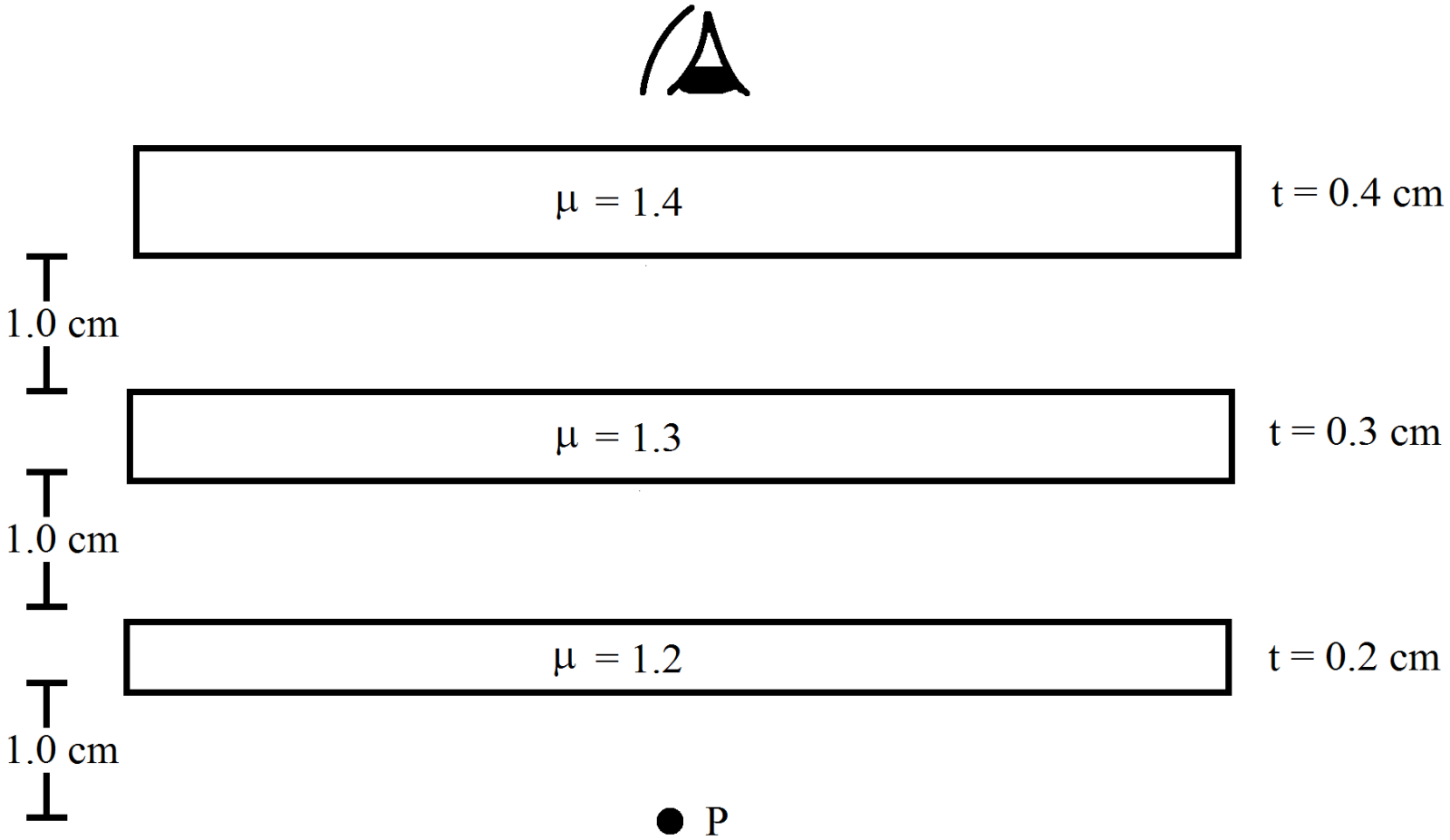
Locate the image of the point P as seen by the eye in the figure.
The kinetic energy of a charged particle decreases by 10J as it moves from a point at potential 100V to a point at potential 200V. Find the charge on the particle.
Explain, with the help of a circuit diagram, the working of a photo-diode. Write briefly how it is used to detect the optical signals.
The electric field in a region is given by $\overrightarrow{\text{E}}=\frac{3}{5}\text{E}_0\overrightarrow{\text{i}}+\frac{4}{5}\text{E}_0\overrightarrow{\text{j}}$ with $\text{E}_0=2.0\times10^3\text{NC}^{-1}.$ Find the flux of this field through a rectangular surface of area $0.2m^2$ parallel to the $y-z$ plane.
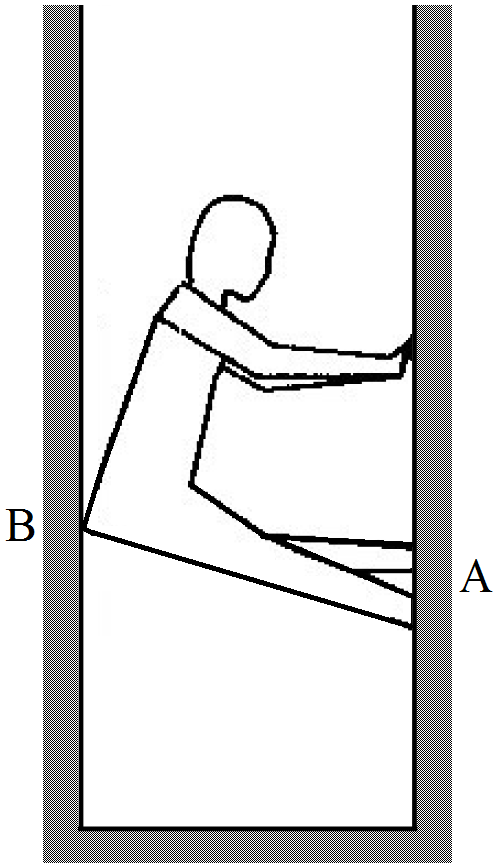
A person $(40\ kg)$ is managing to be at rest between two vertical walls by pressing one wall A by his hands and feet and the other wall B by his back. Assume that the friction coefficient between his body and the walls is $0.8$ and that limiting friction acts at all the contacts.
  1. Show that the person pushes the two walls with equal force.
  2. Find the normal force exerted by either wall on the person. Take $g = 10m/s^2.$
A bar magnet of magnetic moment $1.5 JT ^{-1}$ lies aligned with the direction of a uniform magnetic field of 0.22 T.
(a) What is the amount of work required by an external torque to turn the magnet so as to align its magnetic moment (i) normal to the field direction, (ii) opposite to the field direction?
(b) What is the torque on the magnet in the cases (i) and (ii)?
A 12.5 eV electron beam is used to bombard gaseous hydrogen at room temperature. Upto which energy level the hydrogen atoms would be excited? Calculate the wavelengths of the first member of Lyman and first member of Balmer series.
(a) Identify the part of the electromagnetic spectrum used in (i) radar and (ii) eye surgery. Write their frequency range.
(b) Prove that the average energy density of the oscillating electric field is equal to that of the oscillating magnetic field.
When an apple falls from a tree what happens to its gravitational potential energy just as it reaches the ground? After it strikes the ground?
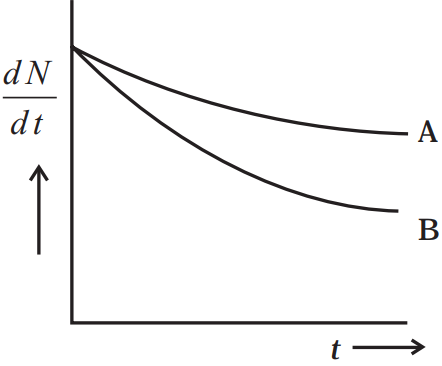
Which sample, A or B shown in Fig. has shorter mean-life?