Question
A capacitor is connected to an alternating-current source. Is there a magnetic field between the plates?

Answer

When an alternating-current source is connected to a capacitor, the electric field between the plates of the capacitor keeps on changing with the applied voltage. Due to the changing electric field, a magnetic field exists in between the plates of the capacitor.

Need a full question paper?

Generate a complete, print-ready paper with questions like this in minutes — across 16+ boards, with answer keys.
Start Generating Free

Similar questions

A charged capacitor of capacitance C is discharged through a resistance R. A radioactive sample decays with an average-life $\tau.$ Find the value of R for which the ratio of the electrostatic field energy stored in the capacitor to the activity of the radioactive sample remains constant in time.
A plate of area $10cm^2$​​​​​​​ is to be electroplated with copper (density $9000kg/m^3$) to a thickness of 10 micrometres on both sides, using a cell of 12V. Calculate the energy spent by the cell in the process of deposition. If this energy is used to heat 100g of water, calculate the rise in the temperature of the water. ECE of copper $= 3 \times 10^{-7}kg C^{-1}$ and specific heat capacity of water $= 4200Jkg^{-1}.$
In a photoelectric experiment, the collector plate is at 2.0V with respect to the emitter plate made of copper ($\phi$ - 4.5eV). The emitter is illuminated by a source of monochromatic light of wavelength 200 run. Find the minimum and maximum kinetic energy of the photoelectrons reaching the collector.
In Joly's differential steam calorimeter, 3g of an ideal gas is contained in a rigid closed sphere at 20°C. The sphere is heated by steam at 100°C and it is found that an extra 0.095g of steam has condensed into water as the temperature of the gas becomes constant. Calculate the specific heat capacity of the gas in $Jg^{-1}\  K^{-1}.$ The latent heat of vaporisation of water $= 540cal-g^{-1}.$
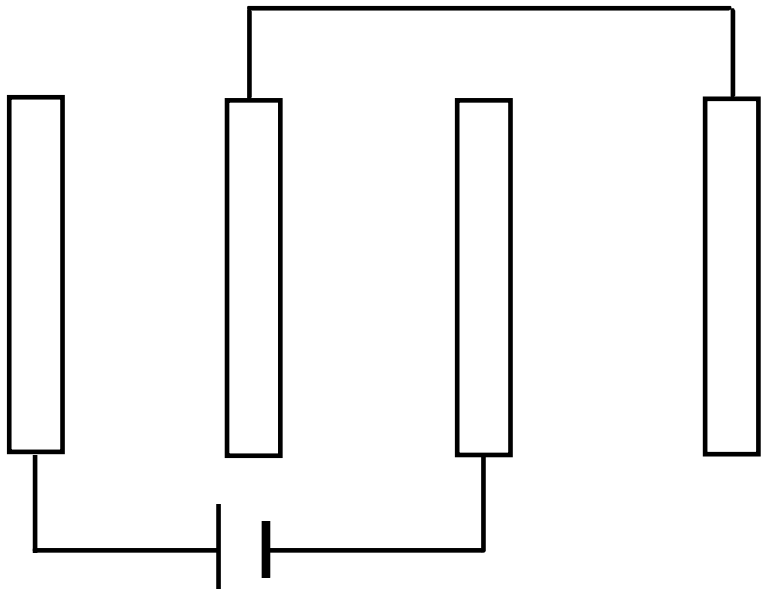
Each of the plates shown in figure has surface area $\Big(\frac{96}{\in_0}\Big)\times10^{-12}\text{Fm}$ on one side and the separation between the consecutive plates is 4.0mm. The emf of the battery connected is 10 volts. Find the magnitude of the charge supplied by the battery to each of the plates connected to it.
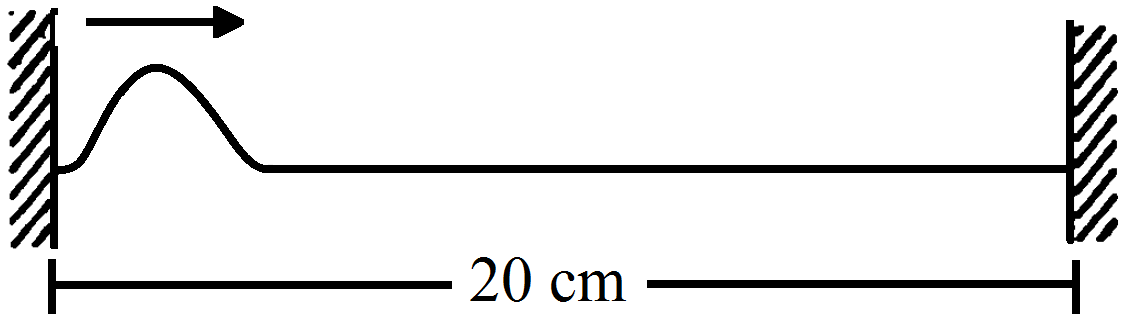
A string of length 20cm and linear mass density 0.40g/cm is fixed at both ends and is kept under a tension of 16N. A wave pulse is produced at t = 0 near an end as shown in figure, which travels towards the other end.
  1. When will the string have the shape shown in the figureagain
  2. Sketch the shape of the string at a time half of that found in part (a).
Consider a thin target $\left(10^{-2} m\right.$ square, $10^{-3} m$ thickness $)$ of sodium, which produces a photocurrent of $100 \mu A$ when a light of intensity $100 W / m ^2(\lambda=660 nm)$ falls on it. Find the probability that a photoelectron is produced when a photon strikes a sodium atom. $[$Take density of $Na =0.97 kg / m ^3 ].$
A thin spherical shell lying on a rough horizontal surface is hit by a cue in such a way that the line of action passes through the centre of the shell. As a result, the shell starts moving with a linear speed v without any initial angular velocity. Find the linear speed of the shell after it starts pure rolling on the surface.
Explain briefly, with the help of a circuit diagram, the transistor action of npn transistor in CE configuration. Draw the typical shapes of input and output characteristics.
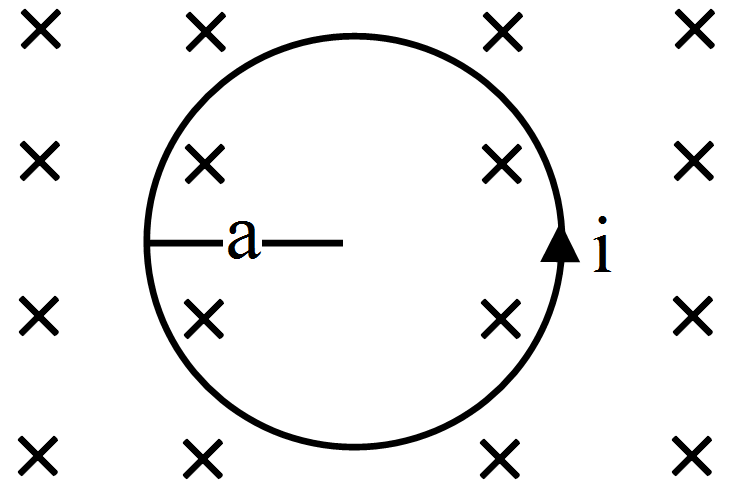
The shows a circular wire loop of radius a and carrying a current i, which is placed in a perpendicular magnetic field B.
  1. Consider a small part dl of the wire. Find the force on this part of the wire exerted by the magnetic field.
  2. Find the force of compression in the wire.