Question
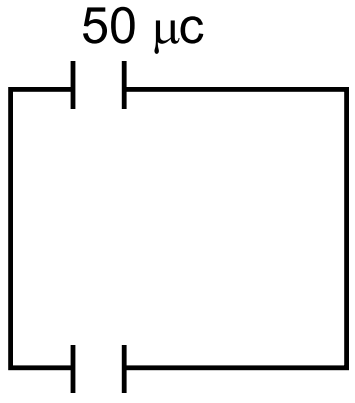
A capacitor stores $50\mu\text{C}$ charge when connected across a battery. When the gap between the plates is filled with a dielectric, a charge of $100\mu\text{C}$ flows through the battery. Find the dielectric constant of the material inserted.

Answer


Initial charge stored $=50\mu\text{c}$

Let the dielectric constant of the material induced be ‘k’.

Now, when the extra charge flown through battery is 100.

So, net charge stored in capacitor $=150\mu\text{c}$

Now, $\text{C}_1=\frac{\in_0\text{A}}{\text{d}}$ or $\frac{\text{q}_1}{\text{V}}=\frac{\in_0\text{A}}{\text{d}}\ \dots(1)$

$\text{C}_2=\frac{\in_0\text{Ak}}{\text{d}}$ or $\frac{\text{q}_2}{\text{V}}=\frac{\in_0\text{Ak}}{\text{d}}\ \dots(2)$

Dividing (1) and (2) we get $\frac{\text{q}_1}{\text{q}_2}=\frac{1}{\text{k}}$

$\Rightarrow\frac{50}{150}=\frac{1}{\text{k}}$

$\Rightarrow\text{k}=3$
Need a full question paper?

Generate a complete, print-ready paper with questions like this in minutes — across 16+ boards, with answer keys.

Start Generating Free

Similar questions

What is Lenz's law of electromagnetic induction? Explain how does it correlate with law of conservation of energy?
A 5mm high pin is placed at a distance of 15cm from a convex lens of focal length 10cm. A second lens of focal length 5cm is placed 40cm from the first lens and 55cm from the pin. Find
  1. The position of the final image.
  2. Its nature.
  3. Its size.
What is Gauss theorem? With its help, obtain an expression for the electric field intensity at any point near a uniformly charged linear conductor of infinite length.###Make the necessary diagram and with the help of Gauss law, calculate the electric field intensity at any point due to a charged wire of infinite length. Plot the change in intensity with distance.###Define Gauss' law. With its help, find the value of electric field intensity at a distance from a uniformly charged linear conductor of infinite extension. Make the necessary diagram and also make a graph of the change of electric field with distance.
A parallel-plate capacitor having plate area 400cm2 and separation between the plates 1.0mm is connected to a power supply of 100V. A dielectric slab of thickness 1.0mm and dielectric constant 5.0 is inserted into the gap:
  1. Find the increase in electrostatic energy.
  2. If the power supply is now disconnected and the dielectric slab is taken out, find the further increase in energy.
  3. Why does the energy increase in inserting the slab as well as in taking it out?
Two identical metal balls one at $\text{T}_1=300\text{K}$ and the other at $\text{T}_2=600\text{K}$ are kept at a distance of 1m in vacuum. Will the temperatures equalise by radiation? Will the rate of heat gained by the colder sphere be proportional to $\text{T}_2^4-\text{T}_1^4$ as may be expected from the Stefan's law?
What is meant by electric field lines? Give examples of electric field lines due to different charge distributions and also write their characteristics.
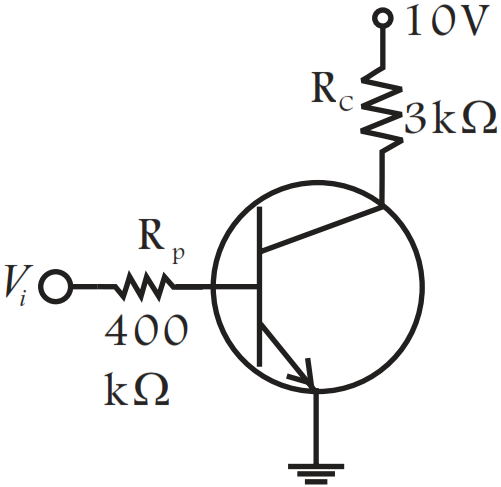
In the circuit shown in Fig., when the input voltage of the base resistance is 10V, Vbe is zero and Vce is also zero. Find the values of Ib, Ic and β.

Obtain an expression for induced electromotive force due to rotational motion of a disc in a uniform magnetic field.
Derive a mathematical expression for the force per unit length experienced by each of the two long current carrying conductors placed parallel to each other in air. Hence define one ampere of current.

Explain why two parallel straight conductors carrying current in the opposite direction kept near each other in air repel?

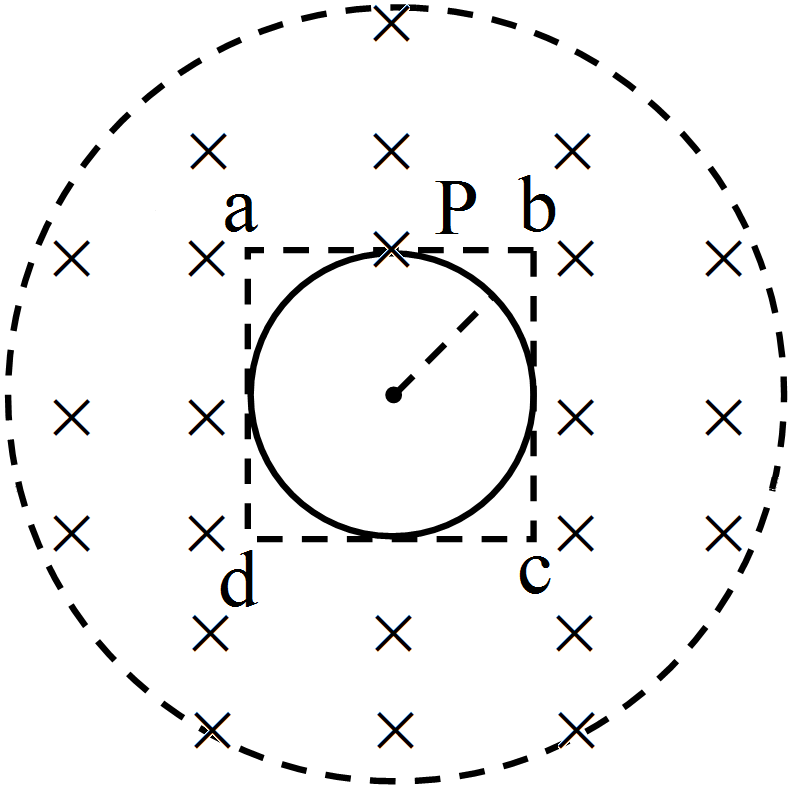
A uniform magnetic field B exists in a cylindrical region, shown dotted in figure. The magnetic field increases at a constant rate $\frac{\text{dB}}{\text{dt}}.$ Consider a circle of radius r coaxial with the cylindrical region.

  1. Find the magnitude of the electric field E at a point on the circumference of the circle.
  2. Consider a point P on the side of the square circumscribing the circle. Show that the component of the induced electric field at P along ba is the same as the magnitude found in part (a).