Question
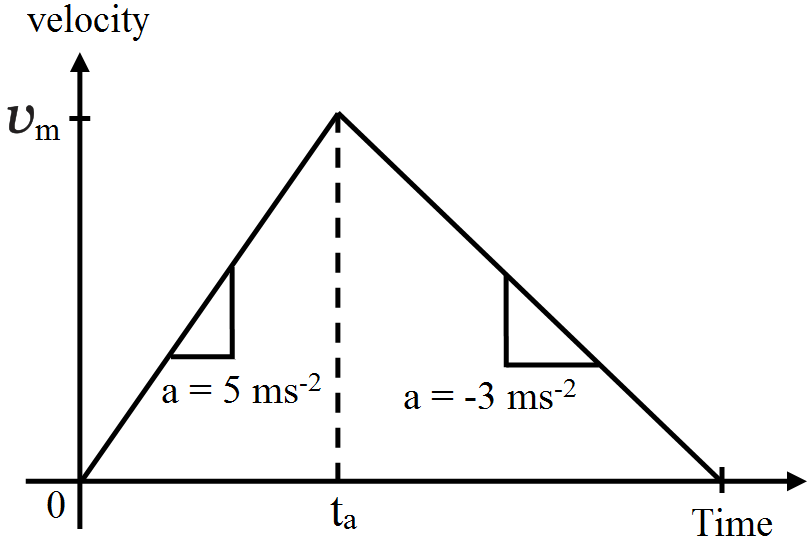
A car starting from rest, accelerates uniformly with $5m/s^2$ for sometime and then decelerates to come to rest with $3m/s^2$. Find the maximum velocity attained during the motion and the distance covered in a total time of 6 seconds of the journey.
Answer

During acceleration, $\text{v}_\text{m}=0+5\times\text{t}_\text{a}$
$\Rightarrow \text{t}_\text{a}=\frac{\text{v}_\text{m}}{5}$
$\text{v}^2_\text{m}=0+2\times5\times\text{s}_\text{a}$
$\Rightarrow \text{s}_\text{a}=\frac{\text{v}^2_\text{m}}{10}$

During deceleration, $0=\text{v}_\text{m}-3\text{t}_\text{d}$
$\Rightarrow \text{t}_\text{d}=\frac{\text{v}_\text{m}}{3}$
$0=\text{v}^2_\text{m}-2\times3\times\text{s}_\text{d}$
$\Rightarrow \text{s}_\text{d}=\frac{\text{v}^2_\text{m}}{6}$ Total time $=6=\text{t}_\text{a}+\text{t}_\text{d}$
$\therefore \text{v}_\text{m}=\frac{6\times5\times3}{8}=11.25\text{ms}^{-1}$ Total length covered $=\text{s}_\text{a}+\text{s}_\text{d}=\text{v}^2_\text{m}\Big(\frac{1}{10}+\frac{1}{6}\Big)$
$=(11.25)^2\frac{16}{60}$
$=33.75\text{m}$

Need a full question paper?

Generate a complete, print-ready paper with questions like this in minutes — across 16+ boards, with answer keys.

Start Generating Free

Similar questions

A body of mass m is attached to one end of a massless spring which is suspended vertically from a fixed point. The mass is held in hand so that the spring is neither stretched nor compressed. Suddenly the support of the hand is removed. The lowest position attained by the mass during oscillation is 4cm below the point, where it was held in hand.
  1. What is the amplitude of oscillation?
  2. Find the frequency of oscillation?
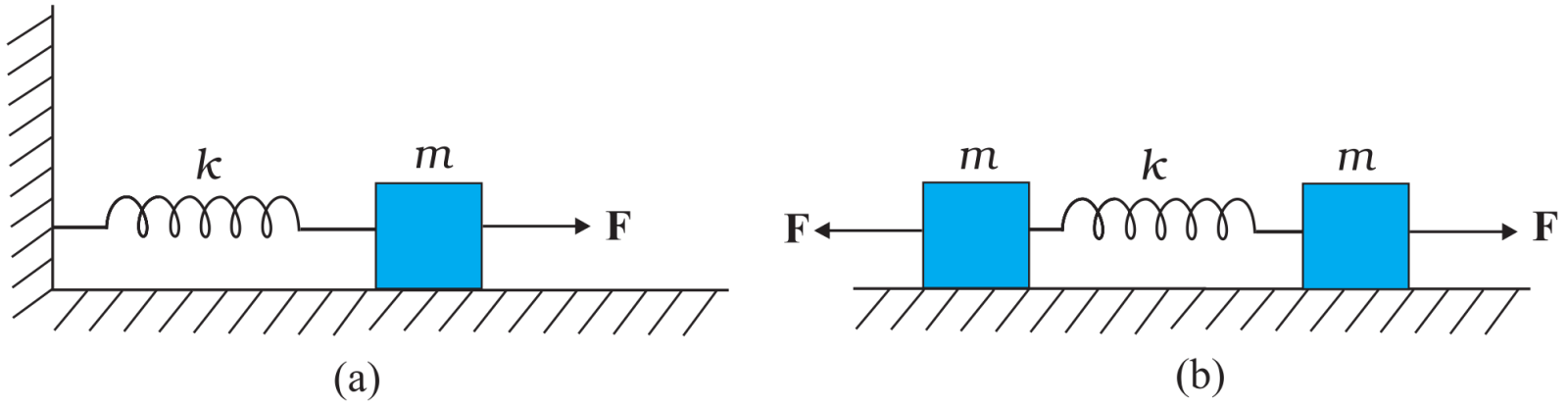
Figure (a) shows a spring of force constant k clamped rigidly at one end and a mass m attached to its free end. A force F applied at the free end stretches the spring. Figure (b) shows the same spring with both ends free and attached to a mass m at either end. Each end of the spring in Fig. (b) is stretched by the same force F.
If the mass in Fig. (a) and the two masses in Fig. (b) are released, what is the period of oscillation in each case?
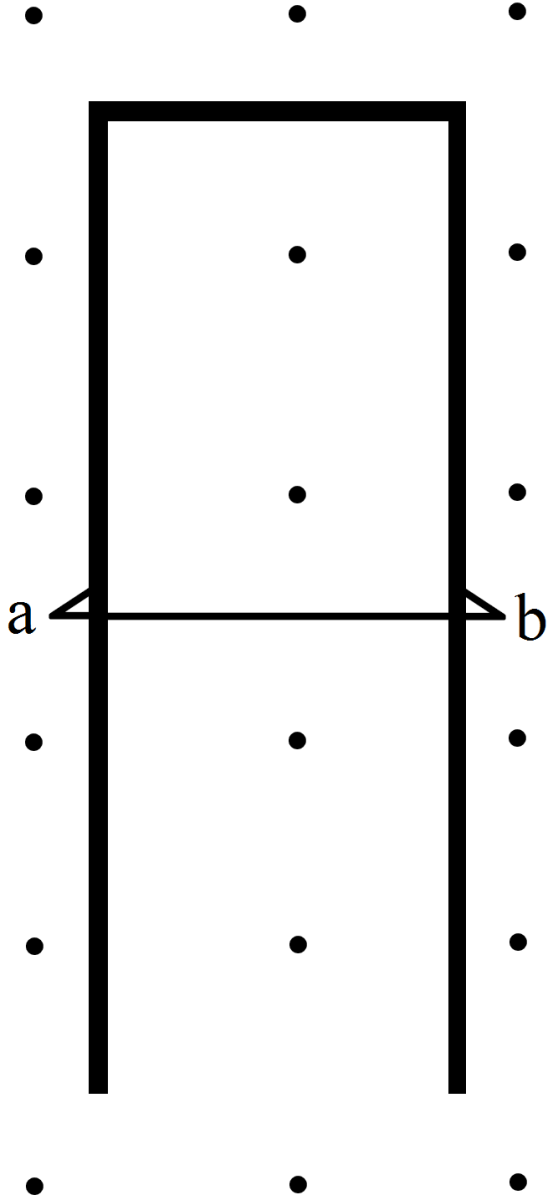
A conducting wire ab of length l, resistance r and mass m starts sliding at $t = 0$ down a smooth, vertical, thick pair of connected rails as shown in figure. A uniform magnetic field B exists in the space in a direction perpendicular to the plane of the rails.
  1. Write the induced emf in the loop at an instant t when the speed of the wire is v.
  2. What would be the magnitude and direction of the induced current in the wire?
  3. Find the downward acceleration of the wire at this instant.
  4. After sufficient time, the wire starts moving with a constant velocity. Find this velocity $v_m$​​​​​​​.
  5. Find the velocity of the wire as a function of time.
  6. Find the displacement of the wire as a function of time.
  7. Show that the rate of heat developed in the wire is equal to the rate at which the gravitational potential energy is decreased after steady state is reached.
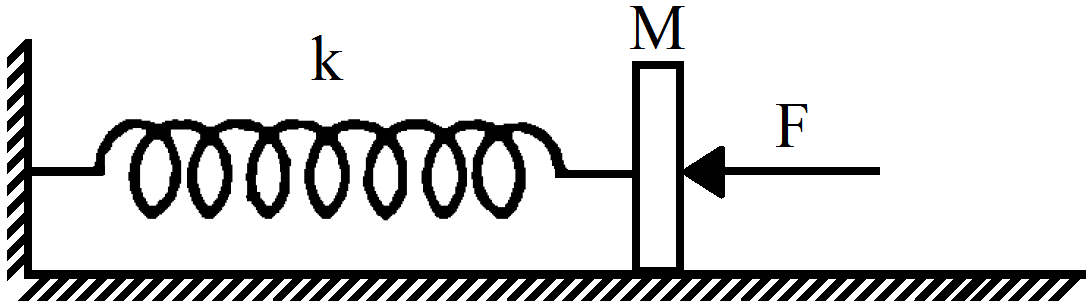
In figure k = 100N/m, M = 1kg and F = 10N,
  1. Find the compression of the spring in the equilibrium position.
  2. A sharp blow by some external agent imparts a speed of 2m/s to the block towards left. Find the sum of the potential energy of the spring and the kinetic energy of the block at this instant.
  3. Find the time period of the resulting simple harmonic motion.
  4. Find the amplitude.
  5. Write the potential energy of the spring when the block is at the left extreme.
  6. Write the potential energy of the spring when the block is at the right extreme.
The answers of (b), (e) and (f) are different. Explain why this does not violate the principle of conservation of energy.
Calculate work done in raising a stone of mass $5kg$ of specific gravity $3$ immersed in water from a depth of $6m$ to $1m$ below surface of water($g = 10ms^{-2}$).
The intensity of the sunlight reaching Earth is $1380Wm^{-2}$. Assume this light to be a plane, monochromatic wave. Find the amplitudes of electric and magnetic fields in this wave.
Estimate the mean free path and collision frequency of a nitrogen molecule in a cylinder containing nitrogen at 2.0 atm and temperature 17°C. Take the radius of a nitrogen molecule to be roughly $1.0\mathring{\text{A}}$ Compare the collision time with the time the molecule moves freely between two successive collisions (Molecular mass of $N^2 = 28.0u$).
It is found that yellow light does not eject photoelectrons from a metal. Is it advisable to try with orange light? With green light?
An artificial satellite is revolving around a planet of mass M and radius R, in a circular orbit of radius r. From Kepler’s Third law about the period of a satellite around a common central body, square of the period of revolution T is proportional to the cube of the radius of the orbit r. Show using dimensional analysis, that $\text{T}=\frac{\text{k}}{\text{R}}\sqrt{\frac{\text{r}^3}{\text{g}}},$ where k is a dimensionless constant and g is acceleration due to gravity.
A particle performs SHM on a rectilinear path. Starting from rest, it travels $x_1$ distance in first second and in the next second, it travels $x_2$ distance. Find out the amplitude of this SHM.