MCQ
A carboxylic acid is converted into its anhydride using
- AThionyl chloride
- BSulphur chloride
- CSulphuric acid
- ✓Phosphorus pentoxide
$\begin{array}{*{20}{c}}
{RCOOH} \\
{RCOOH}
\end{array}\,\xrightarrow{{{P_2}{O_5}}}$ $\begin{array}{*{20}{c}}
{RCO} \\
{RCO}
\end{array} > O + {H_2}O$
Generate a complete, print-ready paper with questions like this in minutes — across 16+ boards, with answer keys.
| Column $I$ | Column $II$ | ||
| $(A)$ | Kohlrausch law can calculate | $(P)$ | $\frac{{\Lambda _m^c}}{{\Lambda _m^o}}$ |
| $(B)$ | Molar conductance ${\Lambda _m}$ | $(Q)$ | $\frac{1}{R} \times \frac{l}{A}$ |
| $(C)$ | Specific conductance Kappa $\to (k)$ | $(R)$ | $\Lambda _m^o\,of\,c{a_3}{(P{O_4})_2}$ |
| $(D)$ | Degree of ionization of weak electrolyte | $(S)$ | $\frac{{k \times 1000}}{M}$ |
Which of the following option show correct matches
$C{H_3}COOH\xrightarrow{{SOC{l_2}}}A\mathop {\xrightarrow{{Benzene}}}\limits_{Anhr.\,AlC{l_3}} B\xrightarrow{{HCN}}C\xrightarrow{{HOH}}D.$
The curves $M$ and $N$ represent the variation of energy with reaction coordinate for the reaction in absence and presence of catalyst
Which value represents the activation energy $(E_a)$ for the backward reaction in the presence of catalyst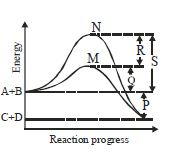
Major product of above reaction is

(Density of water $= 1\,gm/ml$ )