MCQ
A cathode emits $1.8 \times 10^{14}$ electrons per second, when heated. When 400V is applied to anode all the emitted electrons reach the anode. The charge on electron is ${1.6} \times 10^{-19} \mathrm{C}$. The maximum anode current is
  • A
    2.7 μA
  • 29 μA
  • C
    72 μA
  • D
    29 μA

Answer

Correct option: B.
29 μA
(b) 29 μA

Need a full question paper?

Generate a complete, print-ready paper with questions like this in minutes — across 16+ boards, with answer keys.

Start Generating Free

Similar questions

Ozone layer blocks the radiation of wavelength
After five half lives what will be the fraction of initial substance
 
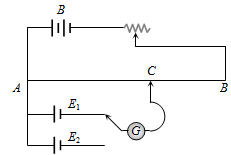
The circuit shown here is used to compare the e.m.f. of two cells $E_1$ and $E_2\left(E_1>E_2\right)$. The null point is at C when the galvanometer is connected to $E_1$. When the galvanometer is connected to $E_2$, the null point will be
Hydrogen (H), deuterium (D), singly ionized helium ($He^+$) and doubly ionized lithium (Li) all have one electron around the nucleus. Consider n =2 to n = 1 transition. The wavelengths of emitted radiations are $\lambda 1,\lambda 2, \lambda 3$ and $\lambda 4$ respectively. Then approximately
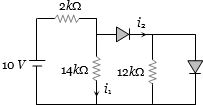
In the following circuit find  $i_1$ and $i_2$
A concave lens and a convex lens have same focal length of 20 cm and both put in contact this combination is used to view an object 5 cm long kept at 20 cm from the lens combination. As compared to object the image will be
In conductor when electrons move between two collisions, their paths are $... A...$ when external fields are absent and $... B...$ when external filed is present. Here, $A$ and $B$ refer to:
A disk of radius $R$ with uniform positive charge density $\sigma$ is placed on the $x y$ plane with its center at the origin. The Coulomb potential along the $z$-axis is

$V(z)=\frac{\sigma}{2 \in_0}\left(\sqrt{R^2+z^2}-z\right)$

A particle of positive charge $q$ is placed initially at rest at a point on the $z$ axis with $z=z_0$ and $z_0>0$. In addition to the Coulomb force, the particle experiences a vertical force $\vec{F}=-c \hat{k}$ with $c>0$. Let $\beta=\frac{2 c \in_0}{q \sigma}$. Which of the following statement($s$) is(are) correct?

$(A)$ For $\beta=\frac{1}{4}$ and $z_0=\frac{25}{7} R$, the particle reaches the origin.

$(B)$ For $\beta=\frac{1}{4}$ and $z_0=\frac{3}{7} R$, the particle reaches the origin.

$(C)$ For $\beta=\frac{1}{4}$ and $z_0=\frac{R}{\sqrt{3}}$, the particle returns back to $z=z_0$.

$(D)$ For $\beta>1$ and $z_0>0$, the particle always reaches the origin.
A positively charged particle is released from rest in an uniform electric field. The electric potential energy of the charge:
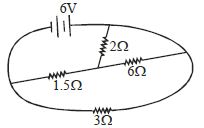
Find the value of current from battery in the circuit ............... $A$