MCQ
A certain orbital has no angular nodes and two radial nodes. The orbital is
- A$2\, s$
- ✓$3\, s$
- C$3\, p$
- D$2\, p$
$n-l-1=2$
$n-1=2$
$n =3$
Generate a complete, print-ready paper with questions like this in minutes — across 16+ boards, with answer keys.
$(I)\,[Xe]\, 6s^1$ $(II)\,[Xe]\,4f^{14}\,5d^1\,6s^2$
$(III)\,[Ar]\,4s^2\,4p^5$ $(IV)\,[Ar]\,3d^7,\,4s^2$
Select the incorrect statement about these elements
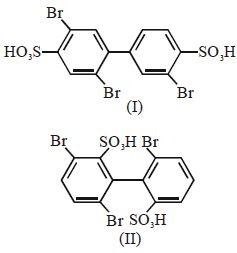
How many structural isomers are possible when one of the hydrogens is replaced by a chlorine atom?