MCQ
A certain weak base has a dissociation constant $2 \times 10^{-5}$. The equilibrium  constant for its neutralisation reaction with strong acid is
  • A
    $2 \times 10^{-5}$
  • B
    $5 \times 10^{10}$
  • C
    $2 \times 10^{-9}$
  • $2 \times 10^{9}$

Answer

Correct option: D.
$2 \times 10^{9}$
d
$\mathrm{K}_{\mathrm{h}}=\frac{\mathrm{k}_{\mathrm{w}}}{\mathrm{k}_{\mathrm{b}}}=\frac{10^{-14}}{2 \times 10^{-5}}=\frac{1}{2} \times 10^{-9}$

$\therefore \mathrm{K}_{\mathrm{N}}=\frac{1}{\mathrm{K}_{\mathrm{h}}}=\frac{1}{\left(1 / 2 \times 10^{-9}\right)}=2 \times 10^{9}$

Need a full question paper?

Generate a complete, print-ready paper with questions like this in minutes — across 16+ boards, with answer keys.

Start Generating Free

Similar questions

Compound $PdCl_4 .6H_2O$ is a hydrated complex; $1\, molal$ aqueous solution of it has freezing point $269.28\, K$. Assuming $100\%$ ionization of complex, calculate the molecular formula of the complex ($K_f$ for water $= 1.86\, K\, kg\, mol^{-1}$)
$+ CH_3I$ (excess) $\to$ product; The product is 
Which is not a electrophile
The concentration of dissolved oxygen $(DO)$ is cold water can go upto ......... $ppm$
What quantity of ammonium sulphate is necessary for the production of $N{H_3}$ gas sufficient to neutralize a solution containing $292\, g$ of $HCl$?.............. $\mathrm{g}$

$[HCl=36.5; {(N{H_4})_2}S{O_4}=132; N{H_3}=17]$
Dissolving $120 \mathrm{~g}$ of urea (mol. wt. $60$) in $1000 \mathrm{~g}$ of water gave a solution of density $1.15 \mathrm{~g} / \mathrm{mL}$. The molarity of the solution is
Which will have the highest enol content?
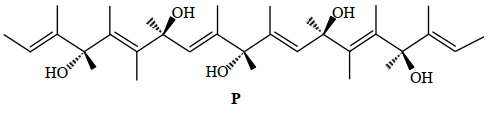
The total number of chiral molecules formed from one molecule of $P$ on complete ozonolysis $\left( O _3, Zn / H _2 O \right)$ is. . . . . . .
Among the following molecule

$(i)$ $Xe{O_3}$ $(ii)$ $XeO{F_4}$ $(iii)$ $Xe{F_6}$

Those having same number of lone pairs on Xe are

For each of the following pairs of $E_2$ reaction, select the one that occurs with  the greater rate constant.

$(1)$ $C{H_3}C{H_2}C{H_2}Cl + $ $\begin{array}{*{20}{c}}
  {\,\begin{array}{*{20}{c}}
  {\,\,\,\,\,\,\,\,\,\,C{H_3}} \\ 
  {\,\,\,|} 
\end{array}} \\ 
  {C{H_3} - C - {O^ - }} \\ 
  {\,\,\,|} \\ 
  {\,\,\,\,\,\,\,\,\,\,C{H_3}} 
\end{array}$                      $(2)$  $C{H_3}C{H_2}C{H_2}I + $$\begin{array}{*{20}{c}}
  {\,\begin{array}{*{20}{c}}
  {\,\,\,\,\,\,\,\,\,\,C{H_3}} \\ 
  {\,\,\,|} 
\end{array}} \\ 
  {C{H_3} - C - {O^ - }} \\ 
  {\,\,\,|} \\ 
  {\,\,\,\,\,\,\,\,\,\,C{H_3}} 
\end{array}$

$(3)$  $\begin{array}{*{20}{c}}
  {{H_3}C - CH - C{H_3}} \\ 
  {|\,\,\,\,} \\ 
  {Br\,\,\,} 
\end{array}$  $+CH_3O^-$                      $(4)$  $\begin{array}{*{20}{c}}
  {{H_3}C - CH - C{H_3}} \\ 
  {|\,\,\,\,} \\ 
  {Br\,\,\,} 
\end{array}$ $+CH_3S^-$
