A certain wire has a resistance $R$. The resistance of another wire identical with the first except having twice its diameter is
Easy


Download our appand get started for free
Experience the future of education. Simply download our apps or reach out to us for more information. Let's shape the future of learning together!No signup needed.*
Similar Questions
- 1View SolutionExpress which of the following setups can be used to verify Ohm’s law
- 2View SolutionWe are able to obtain fairly large currents in a conductor because
- 3A strip of copper and another of germanium are cooled from room temperature to $80\, K$. The resistance ofView Solution
- 4A wire of diameter $0.02\,meter$ contains $10^{28}$ free electrons per cubic meter. For an electrical current of $100\, A$, the drift velocity of the free electrons in the wire is nearlyView Solution
- 5The potential difference between $A$ and $B$ in the Figure is ................. $V$View Solution

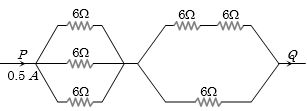
- 6Resistances of $6\, ohm$ each are connected in the manner shown in adjoining figure. With the current $0.5\,ampere$ as shown in figure, the potential difference ${V_P} - {V_Q}$ is .............. $V$View Solution
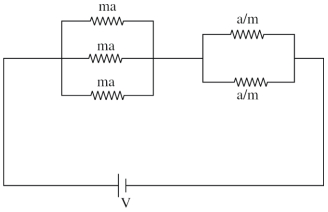
- 7In the given circuit ' $a$ ' is an arbitrary constant. The value of $m$ for which the equivalent circuit resistance is minimum, will be $\sqrt{\frac{ x }{2}}$. The value of $x$ is ...........View Solution
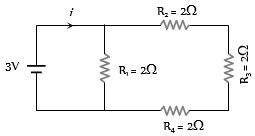
- 8What is the current $(i)$ in the circuit as shown in figure ........... $A$View Solution
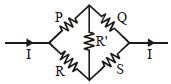
- 9Wheat stone bridge is balanced. Find ratio of electric power dissipated in $(P + Q)$ to $(R + S)$View Solution
- 10A dry cell has an $e.m.f.$ of $1.5\, V$ and an internal resistance of $0.05\,\Omega $. The maximum current obtainable from this cell for a very short time interval is ................... $A$View Solution