MCQ
A charge $q_1$ exerts some force on a second charge $q_2$. If third charge $q_3$ is brought near, the force of $q_1$ exerted on $q_2$
  • A
    Decreases
  • B
    Increases
  • Remains unchanged
  • D
    Increases if $q_3$ is of the same sign as $q_1$ and decreases if $q_3$ is of opposite sign
Answer

Correct option: C.
Remains unchanged
(c) Remains unchanged

Need a full question paper?

Generate a complete, print-ready paper with questions like this in minutes — across 16+ boards, with answer keys.

Start Generating Free

Similar questions

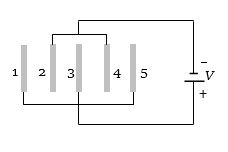
Five identical plates each of area $A$ are joined as shown in the figure. The distance between the plates is $d$. The plates are connected to a potential difference of $V\;volts$. The charge on plates $1$ and $4$ will be
An electron is moving in the north direction. It experiences a force in vertically upward direction. The magnetic field at the position of the electron is in the direction of
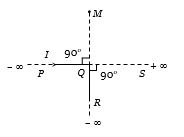
An infinitely long conductor $PQR$ is bent to form a right angle as shown. A current $I$ flows through $PQR$ The magnetic field due to this current at the point $M $ is $H_1$. Now another infinitely long straight conductor $QS$ is connected at $Q$ so that the current is $I/2$ in $QR$ as well as in $QS$, The current in $PQ$ remaining unchanged. The magnetic field at $M$ is now ${H_{2.}}$The ratio ${H_1}/{H_2}$ is given by
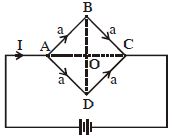
Magnetic field at the centre $O$ of a square loop of side $'a'$ carrying current $I$ as shown in the figure is
A $5.0\, amp$ current is setup in an external circuit by a $6.0\, volt$ storage battery for $6.0$ minutes. The chemical energy of the battery is reduced by
The resistance of a wire is $R$. It is bent at the middle by $180^o$ and both the ends are twisted together to make a shorter wire. The resistance of the new wire is
Direction of magnetic field at any point due to a long current carrying conductor is:
A person wishes to distinguish between two pillars located at a distance of $11\ km$. What should be the minimum distance between these pillars $($resolving power of normal human eye is $1')?$
In Young's experiment, monochromatic light is used to illuminate the two slits $A$ and $B.$ interference fringes are observed on a screen placed infront of the slits. Now if a thin  glass plate is placed normally in the path of the beam coming from the slit $A$, then 
A wire of diameter $0.02\,meter$ contains $10^{28}$ free electrons per cubic meter. For an electrical current of $100\, A$, the drift velocity of the free electrons in the wire is nearly