Question
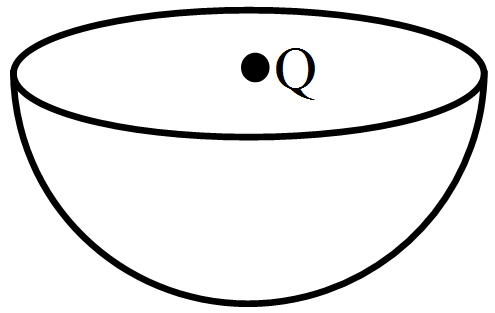
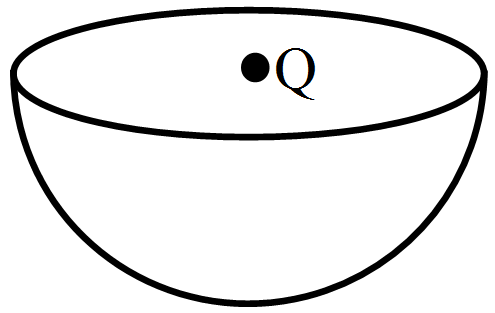
A charge Q is placed at the centre of an imaginary hemispherical surface. Using symmetry arguments and the Gauss's law, find the flux of the electric field due to this charge through the surface of the hemisphere (figure).
Answer

From Guass's law, flux through a closed surface,$\phi=\frac{\text{Q}_{\text{en}}}{\in_0},$
where $Q_{en}$ = charge enclosed by the closed surface Let us assume that a spherical closed surface in which the charge is enclosed is $Q$. The flux through the sphere,$\phi=\frac{\text{Q}}{\in_0}$

Hence for a hemisphere(open bowl), total flux through its curved surface,$\phi'=\frac{\text{Q}}{\in}\times\frac{1}{2}=\frac{\text{Q}}{2\in_0}$

Need a full question paper?

Generate a complete, print-ready paper with questions like this in minutes — across 16+ boards, with answer keys.
Start Generating Free

Similar questions

When two conductors having thermal resistances $\text{R}_1$ and $\text{R}_2$ are joined end to end and placed between two reservoirs, find the equivalent thermal resistance.
The escape speed on the earth is 11.2km/ s.What is its value for a planet having double the radius and eight times the mass of the earth?
The length of the wire shown in figure, between the pulleys is 1.5m and its mass is 12.0g. Find the frequency of vibration with which the wire vibrates in two loops leaving the middle point of the wire between the pulleys at rest.
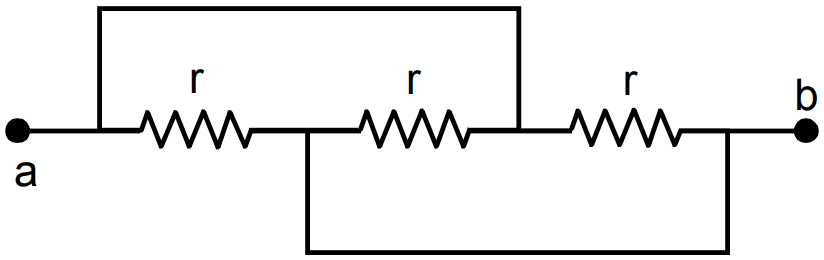
Find the equivalent resistance of the network shown in figure. between the points a and b.
Answer the following: You can shield a charge from electrical forces by putting it inside a hollow conductor. Can you shield a body from the gravitational influence of nearby matter by putting it inside a hollow sphere or by some other means?
A nucleus is at rest in the laboratory frame of reference. Show that if it disintegrates into two smaller nuclei, the products must be emitted in opposite directions.
Explain why cooking is faster in a pressure cooker.
Position $x$ dependents on time
$
x(t)=8+4 t-t^2
$
where distance is measured in meters and time in second. Find the value of instantaneous velocity of the particle at time $t=2 sec$.
A heavy particle of mass m falls freely near the earth's surface. What is the torque acting on this particle about a point 50cm east to the line of motion? Does this torque produce any angular acceleration in the particle?
Figure shows a conducting circular loop of radius a placed in a uniform, perpendicular magnetic field B. A thick metal rod OA is pivoted at the centre O. The other end of the rod touches the loop at A. The centre O and a fixed point C on the loop are connected by a wire OC of resistance R. A force is applied at the middle point of the rod OA perpendicularly, so that the rod rotates clockwise at a uniform angular velocity $\omega.$ Find the force.