Question
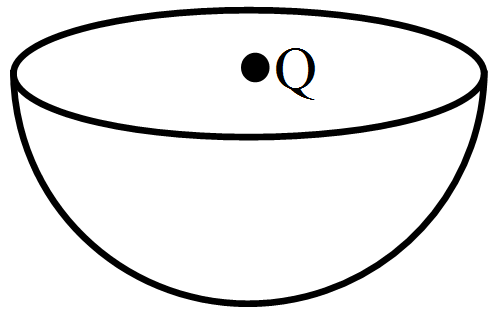
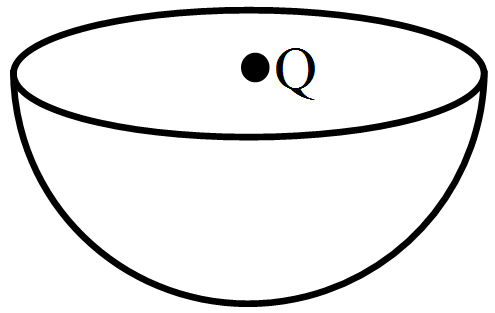
A charge Q is placed at the centre of an imaginary hemispherical surface. Using symmetry arguments and the Gauss's law, find the flux of the electric field due to this charge through the surface of the hemisphere (figure).
Answer

From Guass's law, flux through a closed surface,

$\phi=\frac{\text{Q}_{\text{en}}}{\in_0},$

where

Qen = charge enclosed by the closed surface

Let us assume that a spherical closed surface in which the charge is enclosed is Q.

The flux through the sphere,

$\phi=\frac{\text{Q}}{\in_0}$

Hence for a hemisphere(open bowl), total flux through its curved surface,

$\phi'=\frac{\text{Q}}{\in}\times\frac{1}{2}=\frac{\text{Q}}{2\in_0}$

Need a full question paper?

Generate a complete, print-ready paper with questions like this in minutes — across 16+ boards, with answer keys.

Start Generating Free

Similar questions

A person is standing on a rotating table with metal spheres in his hands. If he withdraw his hands to his chest, what will be the effect on his angular velocity?
A solid sphere of radius R made of a material of bulk modulus B is surrounded by a liquid in a cylindrical container. A mass less piston of area A floats on the surface of the liquid.
When a mass M is placed on the piston to compress the liquid, find fractional change in the radius of the sphere?
A particle moves from a point $\vec{\text{r}}_1=(2\text{m})\vec{\text{i}}+(3\text{m})\vec{\text{j}}$ to another point $\vec{\text{r}}_2=(3\text{m})\vec{\text{i}}+(2\text{m})\vec{\text{j}}$ during which a certain force $\vec{\text{F}}=(5\text{N})\vec{\text{i}}+(5\text{N})\vec{\text{j}}$ acts on it. Find the work done by the force on the particle during the displacement.
A copper sphere is suspended in an evacuated chamber maintained at 300K. The sphere is maintained at a constant temperature of 500K by heating it electrically. A total of 210W of electric power is needed to do it. When the surface of the copper sphere is completely blackened, 700W is needed to maintain the same temperature of the sphere. Calculate the emissivity of copper.
On what factors does the speed of transverse waves setup in a string depend?
The electric current in a charging R-C circuit is given by $\text{i}=\text{i}_0\text{e}^{-\frac{\text{t}}{\text{RC}}}$ where $\text{i}_0,$ R and C are constant parameters of the circuit and t is time. Find the rate of change of current at
  1. t = 0.
  2. t = RC.
  3. t = 10RC.
If net torque on a rigid body is zero, does its linear momentum necessary remain conserved?
The current in a discharging LR circuit is given by $\text{i}=\text{i}_0\text{e}^{\frac{-\text{t}}{\tau}}$ where $\tau$ is the time constant of the circuit. Calculate the rms current for the period $\text{t}=0$ to $\text{t}=\tau.$
A body is being raised to a height h from the surface of earth. What is the sign of work done by
  1. Applied force.
  2. Gravitational force?
What are the measures to reduce the effect of friction? Explain. Explain the usefulness of lubricants.