Question
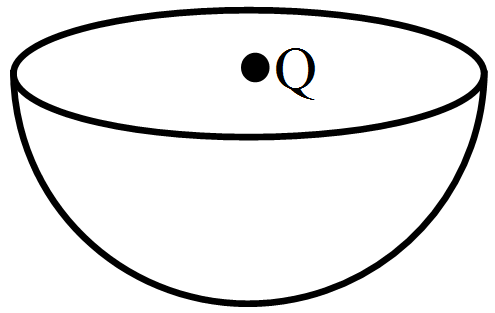
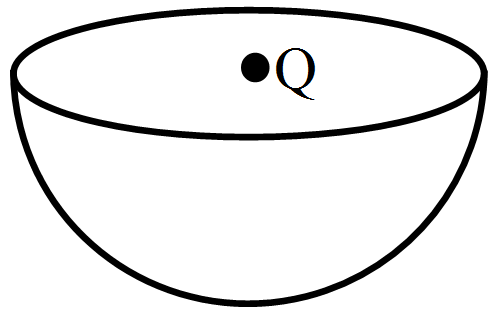
A charge Q is placed at the centre of an imaginary hemispherical surface. Using symmetry arguments and the Gauss's law, find the flux of the electric field due to this charge through the surface of the hemisphere (figure).
Answer

From Guass's law, flux through a closed surface,

$\phi=\frac{\text{Q}_{\text{en}}}{\in_0},$

where

Qen = charge enclosed by the closed surface

Let us assume that a spherical closed surface in which the charge is enclosed is Q.

The flux through the sphere,

$\phi=\frac{\text{Q}}{\in_0}$

Hence for a hemisphere(open bowl), total flux through its curved surface,

$\phi'=\frac{\text{Q}}{\in}\times\frac{1}{2}=\frac{\text{Q}}{2\in_0}$

Need a full question paper?

Generate a complete, print-ready paper with questions like this in minutes — across 16+ boards, with answer keys.
Start Generating Free

Similar questions

The electric force experienced by a charge of 1.0 × 10-6C is 1.5 × 10-3N. Find the magnitude of the electric field at the position of the charge.
Ultraviolet light is incident on two photosensitive materials having work functions W1 and W2 (W1 > W2). In which case will the kinetic energy of the emitted electrons be greater? Why?
Assume that each iron atom has a permanent magnetic moment equal to 2 Bohr magnetons (1 bohr magneton equals 9.27 × 10⁻²⁴A-m2). The density of atoms in iron is 8.52 × 1028 atoms/m3.
  1. Find the maximum magnetization I in a long cylinder of iron.
  2. Find the maximum magnetic field B on the axis inside the cylinder.
Find the wavelength of electromagnetic waves of frequency 5 × 10¹⁹Hz in free space. Give its two applications.
The light emitted in the transition n = 3 to n = 2 in hydrogen is called $\text{H}_\alpha$ light. Find the maximum work function a metal can have so that $\text{H}_\alpha$ light can emit photoelectrons from it.
The angles of dip at two places located on the earth are 0° and 90° respectively. Where are the places located?
A tightly-wound, long solenoid has n turns per unit length, a radius r and carries a current i. A particle having charge q and mass m is projected from a point on the axis in a direction perpendicular to the axis. What can be the maximum speed for which the particle does not strike the solenoid ?
X-ray and visible light travel at the same speed in vacuum. Do they travel at the same speed in glass?
The selling rate of a radioactive isotope is decided by its activity. What will be the second-hand rate of a one month old $\text{ }^{32}\text{P}\big(\text{t}_{\frac{1}{2}}=14.3\text{days}\big)$ source if it was originally purchased for 800 rupees?