Question
A charge Q is uniformly distributed on a thin spherical shell. What is the field at the centre of the shell? If a point charge is brought close to the shell, will the field at the centre change? Does your answer depend on whether the shell is conducting or nonconducting?

Answer

The field at the centre of the shell is zero. As all the charge given to a conductor resides on the surface, the field at any point inside the conducting sphere is zero. Also, the charge distribution at the surface is uniform so, all the electric field vectors due to these charges at the centre are equal and opposite. So, they cancel each other, resulting in a zero net value of the field.
When a charge is brought near the shell, due to induction, opposite polarity charges induce on the surface nearer to the charge and the same polarity charges appear on the face farther from the charge. In this way, a field is generated inside the shell. Hence, the field at the centre is non-zero.
Yes, our answer changes in case of a non-conducting spherical shell. As the charge given to the surface of a non-conducting spherical shell spreads non-uniformly, there is a net electric field at the centre of the sphere.
Need a full question paper?

Generate a complete, print-ready paper with questions like this in minutes — across 16+ boards, with answer keys.

Start Generating Free

Similar questions

  1. Two insulated charged copper spheres $A$ and $B$ have their centres separated by a distance of $50 \ cm$. What is the mutual force of electrostatic repulsion if the charge on each is $6.5 \times 10^{-7} C?$ The radii of A and B are negligible compared to the distance of separation.
  2. What is the force of repulsion if each sphere is charged double the above amount, and the distance between them is halved?
A particle having mass 10g oscillates according to the equation $\text{x}=(2.0\text{cm})\sin\big[(100\text{s}^{-1})\text{t}+\frac{\pi}{6}\big].$ Find (a) the amplitude, the time period and the spring constant (b) the position, the velocity and the acceleration at t = 0.
Two circular coils of radii 5.0cm and 10cm carry equal currents of 21 A. The coils have 50 and 100 turns reepectively and are placed in such a way that their planes as well as the centres coincide. Find the magnitude of the magnetic field B at the common centre of the coils if the currents in the coils are (a) in the same sense (b) in the opposite sense.
It is found that yellow light does not eject photoelectrons from a metal. Is it advisable to try with orange light? With green light?
A $10g$ bullet with a charge of $4.00\mu\text{C}$ is fired at a speed of $270m/s^{-1}$ in a horizontal direction. $A$ vertical magnetic field of $500\mu\text{T}$ exists in the space. Find the deflection of the bullet due to the magnetic field as it travels through $100\ m$. Make appropriate approximations.
Find the reading of the spring balance shown in figure. The elevator is going up with an acceleration of $\frac{\text{g}}{10},$ the pulley and the string are light and the pulley is smooth.
The bob of a simple pendulum has a mass of $40g$ and a positive charge of $4.0 \times 10^{-6}C$. It makes $20$ oscillations in $45s$. A vertical electric field pointing upward and of magnitude $2.5 \times 10^4NC^{-1}$ is switched on. How much time will it now take to complete $20$ oscillations?
A piano wire A vibrates at a fundamental frequency of 600Hz. A second identical wire B produces 6 beats per second with it when the tension in A is slightly increased. Find the ratio of the tension in A to the tension in B.
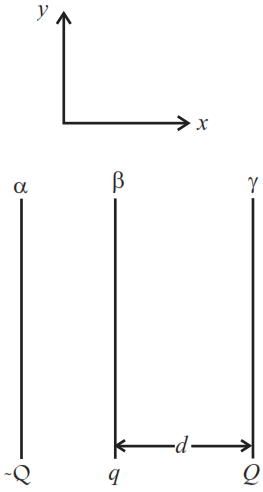
Two fixed, identical conducting plates $(\alpha\ \ \ \beta)$, each of surface area $S$ are charged to $-Q$ and $q,$ respectively, where $Q > q > 0.$ A third identical plate $(\gamma)$, free to move is located on the other side of the plate with charge $q$ at $a$ distance $d ($Fig$).$ The third plate is released and collides with the plate $\beta$. Assume the collision is elastic and the time of collision is sufficient to redistribute charge amongst $\beta\ \ \ \gamma$.

Find the charges on $\beta$ and $\gamma$ after the collision.
(a) Estimate the average drift speed of conduction electrons in a copper wire of cross-sectional area $1.0 \times 10^{-7} m ^2$ carrying a current of 1.5 A. Assume that each copper atom contributes roughly one conduction electron. The density of copper is $9.0 \times 10^3 kg / m ^3$, and its atomic mass is $63.5 u$. (b) Compare the drift speed obtained above with, (i) thermal speeds of copper atoms at ordinary temperatures, (ii) speed of propagation of electric field along the conductor which causes the drift motion.