Question
A charged particle is accelerated through a potential difference of 12kV and acquires a speed of $1.0 \times 10^6m s^{−1}$. It is then injected perpendicularly into a magnetic field of strength 0.2T. Find the radius of the circle described by it.
Answer

$\text{V}=12\text{KV}$$\text{E}=\frac{\text{qV}}{\text{ml}}$
Now, $\text{F}=\text{qE}=\frac{\text{qV}}{\text{l}}$
$\text{a}=\frac{\text{F}}{\text{m}}=\frac{\text{qv}}{\text{ml}}$
$\text{v}=1\times10^6\text{m/s}$
$\text{v}=\sqrt{2\times\frac{\text{qV}}{\text{ml}}\times\text{l}}=\sqrt{2\times\frac{\text{q}}{\text{m}}\times12\times10^3}$
$1\times10^6=\sqrt{2\times\frac{\text{q}}{\text{m}}\times12\times10^3}$
$\Rightarrow10^{12}=24\times10^3\times\frac{\text{q}}{\text{m}}$
$\Rightarrow\frac{\text{m}}{\text{q}}=\frac{24\times10^3}{10^{12}}=24\times10^{-9}$
$\Rightarrow\frac{\text{mV}}{\text{qB}}=\frac{24\times10^{-9}\times1\times10^6}{2\times10^{-1}}=12\times10^{-2}\text{m}=12\text{cm}$

Need a full question paper?

Generate a complete, print-ready paper with questions like this in minutes — across 16+ boards, with answer keys.

Start Generating Free

Similar questions

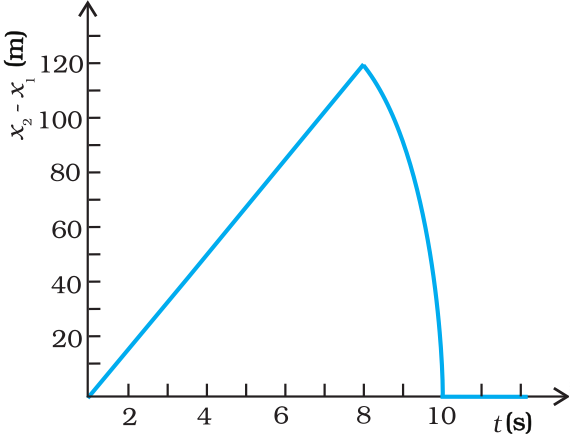
Two stones are thrown up simultaneously from the edge of a cliff $200m$ high with initial speeds of $15m s^{–1}$ and $30m s^{–1}$. Verify that the graph shown in correctly represents the time variation of the relative position of the second stone with respect to the first. Neglect air resistance and assume that the stones do not rebound after hitting the ground. Take $g = 10m s^{–2}$. Give the equations for the linear and curved parts of the plot.
A $2kg$ body and a $3kg$ body are moving along the x-axis. At a particular instant, the $2kg$ body is $1m$ from the origin and has a velocity of $3ms^{-1}$ and the $3kg$ body is $2m$ from the origin and has velocity of $-1 ms^{-1}$. Find the position and velocity of the centre of mass and also find the total momentum.
A particle starts from the origin at t = 0s with a velocity of $10.0\hat{\text{j}}\text{m/s}$ and moves in the x - y plane with a constant acceleration of $(8.0\hat{\text{i}}+2.0\hat{\text{j}})\text{ms}^{-2}.$ (a) At what time is the x- coordinate of the particle 16m? What is the y-coordinate of the particle at that time? (b) What is the speed of the particle at the time?
A glass tube, sealed at both ends, is 100cm long. It lies horizontally with the middle 10cm containing mercury. The two ends of the tube contain air at 27°C and at a pressure 76cm of mercury. The air column on one side is maintained at 0°C and the other side is maintained at 127°C. Calculate the length of the air column on the cooler side. Neglect the changes in the volume of mercury and of the glass.
A rocket is fired vertically with a speed of $5 \mathrm{~km} \mathrm{~s}^{-1}$ from the earth's surface. How far from the earth does the rocket go before returning to the earth? Mass of the earth $=6.0 \times 10^{24} \mathrm{~kg}$; mean radius of the earth $=6.4 \times 10^6 \mathrm{~m}$; $\mathrm{G}=6.67$ $\times 10^{-11} \mathrm{Nm}^2 \mathrm{~kg}^{-2}$.
State Kepler's laws on planetary motion. Explain the way the three laws can be proved.
Explain isothermal, isobaric and adiabatic processes and write equations of state for them.
Given below are densities of some solids and liquids. Give rough estimates of the size of their atoms:
Substance
Atomic Mass(u)
Density $(10^3kgm^{-3})$
Carbon (diamond)
Gold
Nitrogen (liquid)
Lithium
Fluorine (liquid)
12.01
197.00
14.01
6.94
19.00
2.22
19.32
1.00
0.53
1.14
$\big[$Hint: Assume the atoms to be ‘tightly packed’ in a solid or liquid phase, and use the known value of Avogadro’s number. You should, however, not take the actual numbers you obtain for various atomic sizes too literally. Because of the crudeness of the tight packing approximation, the results only indicate that atomic sizes are in the range of a few $\mathring{\text{A}}\big].$
Calculate the total energy of a satellite and define binding energy.
A brass boiler has a base area of $0.15 \mathrm{~m}^2$ and thickness 1.0 cm . It boils water at the rate of $6.0 \mathrm{~kg} / \mathrm{min}$ when placed on a gas stove. Estimate the temperature of the part of the flame in contact with the boiler. Thermal conductivity of brass $=109 \mathrm{~J} \mathrm{~s}^{-1} \mathrm{~m}^{-1} \mathrm{~K}^{-1} ;$ Heat of vaporisation of water $=2256 \times 103 \mathrm{~J} \mathrm{~kg}^{-1}$.