Question
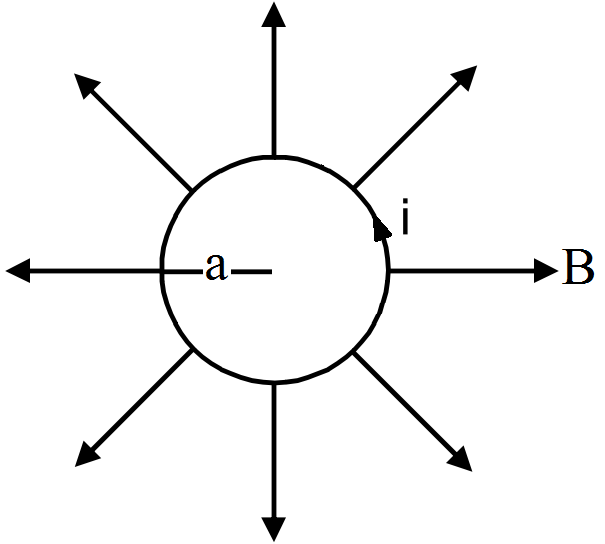
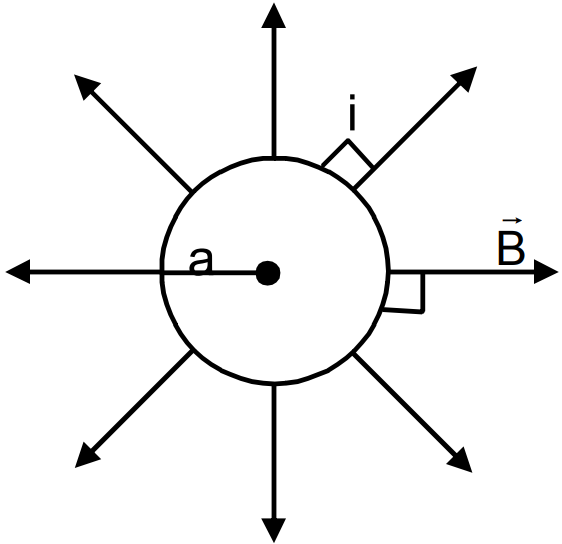
A circular loop of radius a, carrying a current i, is placed in a two-dimensional magnetic field. The centre of the loop coincides with the centre of the field The strength of the magnetic field at the periphery of the loop is B. Find the magnetic force on the wire.
Answer


$\text{l}=2\pi\text{a}$
Magnetic field $=\overrightarrow{\text{B}}$ radially outwards
Current ⇒ 'i'
$\text{F}=\text{i l}\times\text{B}$
$=\text{i}\times(2\pi\text{a}\times\overrightarrow{\text{B}})$
$=2\pi\text{ai B}$ perpendicular to the plane of the figure going inside.

Need a full question paper?

Generate a complete, print-ready paper with questions like this in minutes — across 16+ boards, with answer keys.

Start Generating Free

Similar questions

The band gap for silicon is $1.1eV.$
  1. Find the ratio of the band gap to $kT$ for silicon at room temperature $300K.$
  2. At what temperature does this ratio become one tenth of the value at $300K?$
$($Silicon will not retain its structure at these high temperatures.$)$
Calculate the heat required to convert $3kg$ of ice at $-12^\circ C$ kept in a calorimeter to steam at $100^\circ C$ at atmospheric pressure.
Given specific heat capacity of ice $= 2100 \ J \ kg^{-1} \ K^{-1}$,
specific heat capacity of water $= 4186 \ J \ kg^{-1}\ K^{-1}$,
latent heat of fusion of ice $= 3.35 \times 10^5  \ J \ kg^{-1}$
and latent heat of steam $= 2.256 \times 10^6 \ J \ kg^{-1}$. (No heat is absorbed by the calorimeter).
A moving neutron with speed $10^6 m / s$ collides with a deuteron at rest and sticks to it. Find the speed of the combination if masses of the neutron and deuteron are $1.67 \times 10^{-27} kg$ and $3.34 \times 10^{-27} kg$, respectively.
Write the dimensional formula for the following:
  1. Wein’s constant.
  2. Planck's constant.
  3. Specific heat.
  4. Latent heat.
  5. Rydberg's constant.
What is a black body ? Draw the curves showing the energy distribution among black body radiations at different temperature. Hence, define Wein's displacement law. Give one application of Wein's displacement law.
Give example of a situation in which an applied force does not result in a change in kinetic energy.
A particle moving in a straight line covers half the distance with a speed of $3m/s$. The other half of the distance is covered in two equal intervals of time with speeds of $4.5m/s$ and $7.5m/s$, respectively. Find the average speed of the particle during this motion.
Water near the bed of a deep river is quiet while that near the surface flows. Give reasons.
A person of mass m is standing in a lift. Find his apparent weight when the lift is:
  1. Moving upward with uniform acceleration a.
  2. Moving downward with uniform acceleration a (< g).
  3. Falls freely. (g is the acceleration due to gravity).
A constant force of 2.50N accelerates a stationary particle of mass 15g through a displacement of 2.50m. Find the work done and the average power delivered.