Question
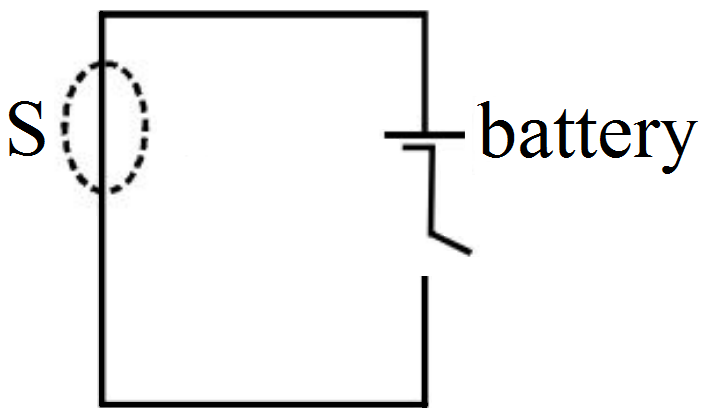
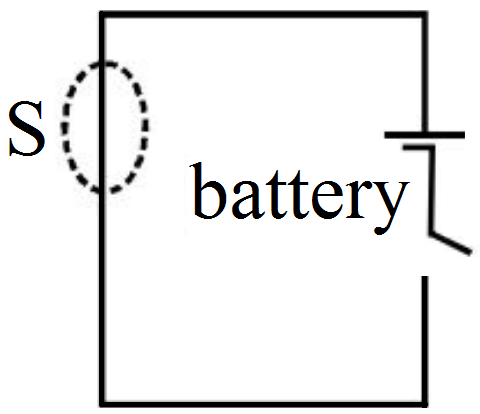
A closed surface S is constructed around a conducting wire connected to a battery and a switch (figure). As the switch is closed, the free electrons in the wire start moving along the wire. In any time interval, the number of electrons entering the closed surface S is equal to the number of electrons leaving it. On closing the switch, the flux of the electric field through the closed surface:
  1. Is increased.
  2. Is decreased.
  3. Remains unchanged.
  4. Remains zero.

Answer

  1. Remains unchanged.

Explanation:

The flux of the electric field through the closed surface is remain unchanged.

Because the no. of electric field lines enter in the closed path = no. of electric field lines existsin the closed path.

Need a full question paper?

Generate a complete, print-ready paper with questions like this in minutes — across 16+ boards, with answer keys.

Start Generating Free

Similar questions

A motor cyclist going round in a circular track at constant speed has
A travelling wave pulse is given by $y=\frac{4}{3 x^2+48 t^2+24 x t+2}$ where $x$ and $y$ are in metre and $t$ is in second. The velocity of wave is ........... $m / s$
Two circular loops of equal radii are placed coaxially at some separation. The first is cut and a battery is inserted in between to drive a current in it. The current c~anges slightly because of the variation in resistance with temperature. During this period, the two loops:
  1. Attract each other.
  2. Repel each other.
  3. Do not exert any force on each other.
  4. Attract or repel each other depending on the sense of the current.
A person speaking normally produces a sound intensity of $40\,dB$ at a distance of $1\,m$. If the threshold intensity for reasonable audibility is $20\,dB,$ the maximum distance at which he can be heard clearly is ... $m$
Two cars $A$ and $B$ are moving in same direction with velocities $30 \,m / s$ and $20 \,m / s$. When car $A$ is at a distance $d$ behind the car $B$, the driver of the car $A$ applies brakes producing uniform retardation of $2 \,m / s ^2$. There will be no collision when ......... $m$
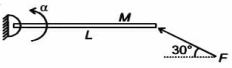
The thin rod shown below has mass $M$ and length $L$. A force $F$ acts at one end as shown and the rod is free to rotate about the other end in the plane of force. Initial angular acceleration of the rod is ........
A ball moving with a velocity of $6\, m/s$ strikes an identical stationary ball. After collision each ball moves at an angle of $30^o$ with the original line of motion. What are the speeds of the balls after the collision ?
A sphere is rotating about a diameter:
  1. The particles on the surface of the sphere do not have any linear acceleration.
  2. The particles on the diameter mentioned above do not have any linear acceleration.
  3. Different particles on the surface have different angular speeds.
  4. All the particles on the surface have same linear speed.
A mass of 5kg is moving along a circular path of radius 1m. If the mass moves with 300 revolutions per minute, its kinetic energy would be:
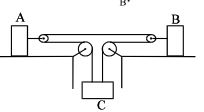
If acceleration of $A$ is $2 \,\,m/s^2$ to left and acceleration of $B$ is $1\,\,m/s^2$ to left, then acceleration of $C$ is