MCQ
A co-ordination complex compound of cobalt has the molecular formulae containing five ammonia molecules, one nitro group and two chlorine atoms for one cobalt atom. One mole of this compound produces three mole ions in an aqueous solution on reacting with excess of $AgN{O_3},$ $AgCl$ precipitate. The ionic formula for this complex would be:
  • $[Co{(N{H_3})_5}(N{O_2})]C{l_2}$
  • B
    $[Co{(N{H_3})_5}Cl][Cl(N{O_2})]$
  • C
    $[Co{(N{H_3})_4}(N{o_2})Cl]\,[(N{H_3})Cl]$
  • D
    $[Co{(N{H_3})_5}][{(N{O_2})_2}C{l_2}]$
Answer

Correct option: A.
$[Co{(N{H_3})_5}(N{O_2})]C{l_2}$
a
(a)The most probable complex which gives three moles ions in aqueous solution may be $[Co{(N{H_3})_5}N{O_2}]C{l_2}$ because it gives two chlorine atoms on ionisation.
$[Co{(N{H_3})_5}N{O_2}]C{l_2} \to {[Co{(N{H_3})_5}N{O_2}]^{2 + }} + 2C{l^ - }$

Need a full question paper?

Generate a complete, print-ready paper with questions like this in minutes — across 16+ boards, with answer keys.

Start Generating Free

Similar questions

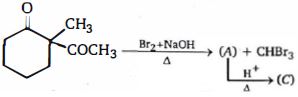
Product $(C)$ of the reaction is
Which one is most reactive towards ${S_{{N^1}}}$ reaction ?
In a cyclotrimetaphosphoric acid molecule, how many single and double bonds are present?
$\begin{matrix}
   {{H}_{2}}C=CH-C{{H}_{2}}-C{{H}_{2}}-CH-C{{H}_{3}}\xrightarrow[Pyridine]{SOC{{l}_{2}}}  \\
   \,\,\,\,\,\,\,\,\,\,\,\,\,\,\,\,\,\,\,\,\,\,\,\,\,\,\,\,\,\,\,\,\,\,\,\,\,\,\,| \,\,\,\,\,\,\,\, \\
   \,\,\,\,\,\,\,\,\,\,\,\,\,\,\,\,\,\,\,\,\,\,\,\,\,\,\,\,\,\,\,\,\,\,\,\,\,\,\,\,\,\,OH\,\,\,\,\,\,  \\
\end{matrix}$  $(A)\xrightarrow[({{H}_{2}}O)]{{{O}_{3}}/Zn}\underset{{{C}_{5}}{{H}_{9}}ClO}{\mathop{(B)}}\,\xrightarrow{NaB{{H}_{4}}}(C)$

Compound $(C)$ is

An aqueous solution of a solute $AB$ has normal boiling point of $101.08\,^oC$ and normal freezing point of $- 1.80\,^oC$. Hence,$ AB$

Given : $AB$ is $100\%$ ionised at boiling point of the solution, ($K_b / K_f $) water $= 0.3$

The reactions of $Cl _2$ gas with cold-dilute and hot-concentrated $NaOH$ in water give sodium salts to two (different) oxoacids of chlorine, $P$ and $Q$, respectively. The $Cl _2$ gas reacts with $SO _2$ gas, in presence of charcoal, to give a product $R$. $R$ reacts with white phosphours to give a compound $S$. On hydrolysis, $S$ gives an oxoacid of phosphours $T$

$1.$ $P$ and $Q$, respectively, are the sodium salts of

$(A)$ hypochlorus and chloric acids

$(B)$ hypochlorus and chlorus acids

$(C)$ chloric and perchloric acids

$(D)$ chloric and hypochlorus acids

$2.$ $R , S$ and $T$, respectively, are

$(A)$ $SO _2 Cl _2, PCl _5$ and $H _3 PO _4$

$(B)$ $SO _2 Cl _2, PCl _3$ and $H _3 PO _3$

$(C)$ $SOCl _2, PCl _3$ and $H _3 PO _2$

$(D)$ $SOCl _2, PCl _5$ and $H _3 PO _4$

Give the answer question $1$ and $2.$

.
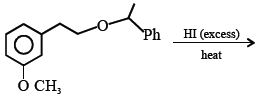
For the given reaction 'D' will be :
Image
Which one of the following lanthanoids does not form $MO _{2} ?$ [$M$ is lanthanoid metal]
The correct name for the complex ion $[CoCl(ONO)(en)_2]^+$ is