MCQ
A coconut fruit hanging high in a palm tree has $.........$ owing to its location.
  • A
    Free energy.
  • B
    Kinetic energy.
  • C
    Activation energy.
  • Potential energy.

Answer

Correct option: D.
Potential energy.
The potential energy possessed by the object is the energy present in it by virtue of its position or configuration. So, the hanging coconut has potential energy due to its location $($height$).$

Need a full question paper?

Generate a complete, print-ready paper with questions like this in minutes — across 16+ boards, with answer keys.

Start Generating Free

Similar questions

Match the thermodynamic processes taking place in a system with the correct conditions. In the table: $\Delta Q$ is the heat supplied, $\Delta W$ is the work done and $\Delta U$ is change in internal energy of the system
Process Condition
$(I)$ Adiabatic $(A)\; \Delta W =0$
$(II)$ Isothermal $(B)\; \Delta Q=0$
$(III)$ Isochoric $(C)\; \Delta U \neq 0, \Delta W \neq 0 \Delta Q \neq 0$
$(IV)$ Isobaric $(D)\; \Delta U =0$
An insulator container contains $4\, moles$ of an ideal diatomic gas at temperature $T.$ Heat $Q$ is supplied to this gas, due to which $2 \,moles$ of the gas are dissociated into atoms but temperature of the gas remains constant. Then
A glass flask contains some mercury at room temperature. It is found that at different temperatures the volume of air inside the flask remains the same. If the volume of mercury in the flask is $300 \,\,cm^3$, then volume of the flask is ........ $cm^3$. (given that coefficient of volume expansion of mercury and coefficient of linear expansion of glass are $1.8 × 10^{-4} (^o C)^{-1}$ and $9 × 10^{-6} (^o C)^{-1}$ respectively)
Two straight metallic strips each of thickness $t$ and length $\ell$ are rivetted together. Their coefficients of linear expansions are $\alpha_1$ and $\alpha_2$. If they are heated through temperature $\Delta T$, the bimetallic strip will bend to form an arc of radius
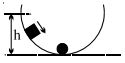
$A$ block of mass $m$ starts from rest and slides down $a$ frictionless semi-circular track from $a$ height $h$ as shown. When it reaches the lowest point of the track, it collides with a stationary piece of putty also having mass $m$. If the block and the putty stick together and continue to slide, the maximum height that the block-putty system could reach is:
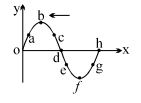
The figure represents the instantaneous picture of a transverse harmonic wave traveling along the negative $x$-axis. Choose the correct alternative $(s)$ related to the movement of the nine points shown in the figure. The points moving upward is/are
The power of water pump is $4 \,kW$. If $g=10 \,ms ^{-2}$, the amount of water it can raise in $1$ minute to a height of $20 \,m$ is ........... $litre$
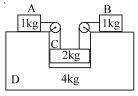
In the system shown in the figure there is no friction anywhere. The block $C$ goes down by $a$ distance $x_0 = 10\, cm$ with respect to wedge $D$ when system is released from rest. The velocity of $A$ with respect to $B$ will be $(g = 10\, m/s^2)$ ......... $m/s$
The energy required to break one bond in $DNA$ is $10^{-20}\, J.$ This value in $eV$ is nearly
The period of oscillation of a simple pendulum of length $L$ suspended from the roof of a vehicle which moves without friction down an inclined plane of inclination $\alpha$, is given by