MCQ
A common emitter amplifier is designed with NPN transistor (a = 0.99). The input impedance is 1 KW and load is 10 KW. The voltage gain will be
  • A
     9.9
  • B
    99
  •  990
  • D
     9900

Answer

Correct option: C.
 990
990

Need a full question paper?

Generate a complete, print-ready paper with questions like this in minutes — across 16+ boards, with answer keys.
Start Generating Free

Similar questions

The electric field at a point on equatorial line of a dipole and direction of the dipole moment:
An achromatic combination of lenses produce:
A conducting resistor is joined with a battery. If the temperature of the conductor is changed with the cooling process, then the magnitude of current flowing:
The de-Broglie wavelength of an electron in the first Bohr orbit is
In optical bench experiment index error is $+1\ cm$ and $-1\ cm$ , between object needle and lens, lens and image needle respectively. Observed values of $u$ and $v$ are $9\ cm$ and $17\ cm$ . Focal length of lens is .....$cm$
An object is placed $12 cm$ to the left of a converging lens of focal length $8 cm. $ Another converging lens of $6 cm$ focal length is placed at a distance of $30 cm$ to the right of the first lens. The second lens will produce
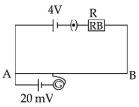
As shown in the figure, a potentiometer wire of resistance $20\,\Omega$ and length $300\,cm$ is connected with resistance box (R.B.) and a standard cell of emf $4\,V$. For a resistance ' $R$ ' of resistance box introduced into the circuit, the null point for a cell of $20\,mV$ is found to be $60\,cm$. The value of ' $R$ ' is $.....\Omega$
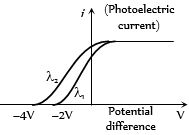
The maximum value of stopping potential in the following diagram is .......... $V$
A capacitor of capacitance $C,$ is connected across an ac source of voltage $\mathrm{V}$, given by

$\mathrm{V}=\mathrm{V}_{0} \sin \omega \mathrm{t}$

The displacement current between the plates of the capacitor, would then be given by :

A point like object is placed at a distance of $1\, m$ in front of a convex lens of focal length $0.5\, m .$ A plane mirror is placed at a distance of $2\,m$ behind the lens. The position and nature of the final image formed by the system is