MCQ
A compound $A $ has a molecular formula ${C_2}C{l_3}OH.$ It reduces Fehling solution and on oxidation gives a monocarboxylic acid $(B)$ . $A$   is obtained by action of chlorine on ethyl alcohol. $ A $ is
  • Chloral
  • B
    $CHC{l_3}$
  • C
    $C{H_3}Cl$
  • D
    Chloroacetic acid

Answer

Correct option: A.
Chloral
a
(a) $\mathop {{C_2}C{l_3}OH}\limits_A + {\rm{Fehling}}\,{\rm{sol}}{\rm{.}} \to \mathop {C{u_2}O}\limits_{{\rm{Red}}\;{\rm{ppt}}} $

It means $-CHO$ group is present.

It means only one  $-CHO$  group is present.

${C_2}{H_5}OH + C{l_2} \to C{H_3}CHO + 2HCl$

$C{H_3}CHO + 3C{l_2} \to \mathop {CC{l_3}CHO}\limits_{{\rm{Chloral}}} + 3HCl$

Need a full question paper?

Generate a complete, print-ready paper with questions like this in minutes — across 16+ boards, with answer keys.

Start Generating Free

Similar questions

If $CO$ ligands are substituted by $NO$ in respective neutral carbonyl compounds  then which of the following will not be correct formula ?
Arrange in their increasing order of equilibrium constants for hydration ?

$\underset{(A)}{\mathop{\begin{matrix}
   O  \\
   ||  \\
   C{{H}_{3}}-C-C{{H}_{3}},  \\
\end{matrix}}}\,\,\,\,\,\underset{(B)}{\mathop{\begin{matrix}
   \,\,\,\,\,\,O  \\
   \,\,\,\,\,\,||  \\
   C{{H}_{3}}-C-H,  \\
\end{matrix}}}\,\,\,\,\,\underset{(C)}{\mathop{\begin{matrix}
   O\,\,\,\,\,\,\,\,\,\,\,\,\,\,  \\
   ||\,\,\,\,\,\,\,\,\,\,\, \,\, \\
   C{{H}_{3}}-C-C{{H}_{2}}-Cl,  \\
\end{matrix}}}\,$ $\,\,\underset{(D)}{\mathop{\begin{matrix}
   O  \\
   ||  \\
   H-C-H,  \\
\end{matrix}}}\,\,\,\,\underset{(E)}{\mathop{\begin{matrix}
   \,\,\,\,\,\,\,\,\,\,\,\,\,\,\,\,\,\,\,\,O  \\
   \,\,\,\,\,\,\,\,\,\,\,\,\,\,\,\,\,\,\,\,||  \\
   Cl-C{{H}_{2}}-C-H  \\
\end{matrix}}}\,$
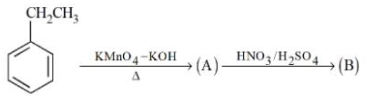
Major product $\mathrm{B}$ of the following reaction has . . . . . . .$\pi$-bond.
The denticity of an organic ligand, biuret is :
Which one of the following statements related to lanthanons is incorrect ?
The compound $A$ with following sequence of reaction gave benzoic acid.

$A\xrightarrow{NaN{{O}_{2}}/HCl}B\xrightarrow{KCN}C\xrightarrow{{{H}_{3}}{{O}^{+}}}$  benzoic acid

The compound $ A$ is

Among the following, the strongest base is
Lanthanoid contraction occurs because:
With $63\,gm$ of oxalic acid how many litres of $\frac{N}{{10}}$ solution can be prepared .......... $L$
When $ 90\,gm$ of water is mixed with $300\,gm$ of acetic acid. The total number of moles will be