Question
A compound microscope has a magnifying power of $100$ when the image is formed at infinity. The objective has a focal length of $0.5cm$ and the tube length is $6.5cm$. Find the focal length of the eyepiece.
Answer

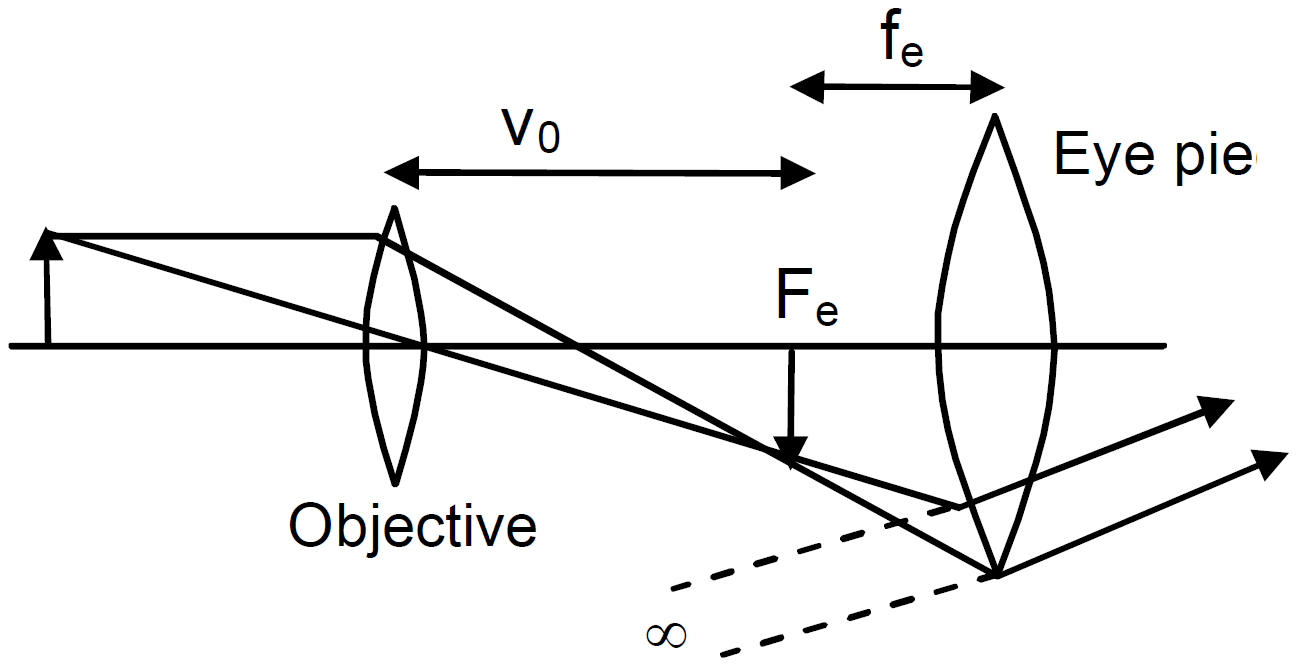
For the give compound microscope, $f_0 = 0.5cm$, tube length = 6.5cm magnifying power = 100 (normal adjustment) Since, the image is formed at infinity, the real image produced by the objective lens should lie on the focus of the eye piece.So, $v_o + f_e = 6.5cm$ ...(1)
Again, magnifying power $\text{m}=\frac{\text{v}_0}{\text{u}_0}\times\frac{\text{D}}{\text{f}_\text{e}}$ [for normal adjustment]
$\Rightarrow\text{m}=\Big[1-\frac{\text{V}_0}{\text{f}_0}\Big]\frac{\text{D}}{\text{f}_\text{e}}$
$\Rightarrow100=-\Big[1-\frac{\text{V}_0}{0.5}\Big]\times\frac{25}{\text{f}_\text{e}}$ [Taking D = 25cm]
$\Rightarrow100\text{f}_\text{e}=-(1-2\text{v}_0)\times25$
$\Rightarrow2\text{v}_0-4\text{f}_\text{e}=1 $ ...(2)
Solving equation (1) and (2) we can get,
$V_0 = 4.5cm$ and $f_e = 2cm$
So, the focal length of the eye piece is 2cm.

Need a full question paper?

Generate a complete, print-ready paper with questions like this in minutes — across 16+ boards, with answer keys.
Start Generating Free

Similar questions

A uniform metre stick of mass 200g is suspended from the ceiling through two vertical strings of equal lengths fixed at the ends. A small object of mass 20g is placed on the stick at a distance of 70cm from the left end. Find the tensions in the two strings.
A cord of negligible mass is wound round the rim of a fly wheel of mass $20 \ kg$ and radius $20 \ cm$. A steady pull of $25 N$ is applied on the cord as shown in Fig. $6.31$. The flywheel is mounted on a horizontal axle with frictionless bearings.
$(a)$ Compute the angular acceleration of the wheel.
$(b)$ Find the work done by the pull, when $2m$ of the cord is unwound.
$(c)$ Find also the kinetic energy of the wheel at this point. Assume that the wheel starts from rest.
$(d)$ Compare answers to parts $(b)$ and $(c).$
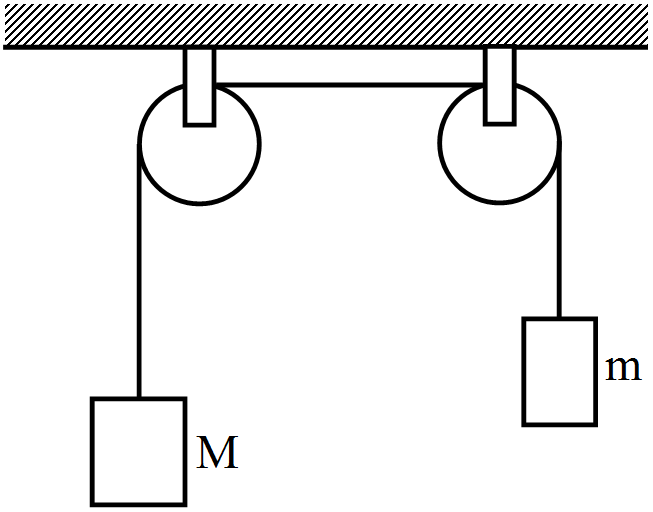
The pulleys in figure are identical, each having a radius R and moment of inertia I. Find the acceleration of the block M.
A space ship is stationed on Mars. How much energy must be expended on the space ship to rocket it out of the solar system? Mass of the spaceship $=1000 \mathrm{~kg}$, mass of the $\mathrm{Sun}=2 \times 10^{30} \mathrm{~kg}$, radius of Mars $=3395 \mathrm{~km}$, Mass of the Mars $=6.4 \times 10^{23} \mathrm{~kg}$. Radius of the orbit of Mars $=2.28 \times 10^{11} \mathrm{~m} . \mathrm{G}=6.67 \times 10^{-11} \mathrm{Nm}^2 \mathrm{~kg}^{-2}$
A tunnel is dug through the centre of the Earth. Show that a body of mass ‘m’ when dropped from rest from one end of the tunnel will execute simple harmonic motion.
A body describes simple harmonic motion with an amplitude of 5cm and a period of 0.2s. Find the acceleration and velocity of the body when the displacement is (a) 5cm (b) 3cm (c) 0cm.
A grindstone has a moment of inertia of $6kg m^2$. A constant torque is applied and the grindstone is found to have a speed of $150rpm, 10s$. after starting from rest. Calculate the torque.
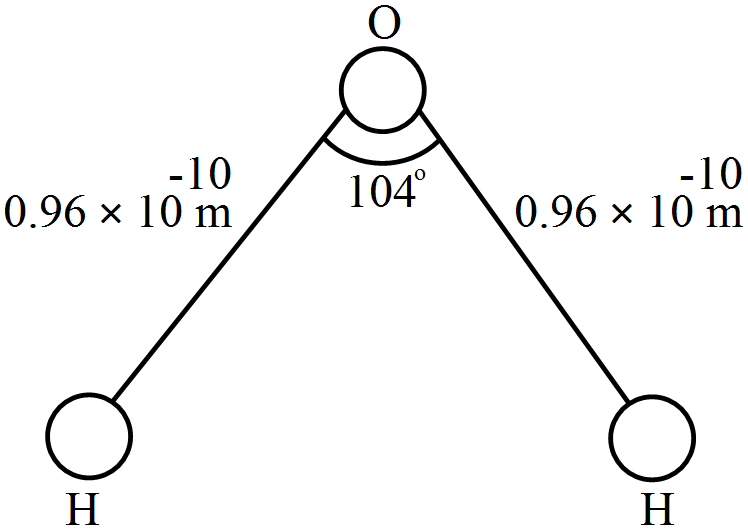
The structure of a water molecule is shown in figure. Find the distance of the centre of mass of the molecule from the centre of the oxygen atom.
The electric field in a region is given by $\overrightarrow{\text{E}}=\frac{\text{E}_0\text{x}}{\text{l}}\vec{\text{i}}.$ Find the charge contained inside a cubical volume bounded by the surfaces $x = 0, x = a, y = 0, y = a, z = 0$ and $z = a$. Take $E_0 = 5 \times 10^3Nc^{-1}, l = 2cm$ and $a = 1cm$.
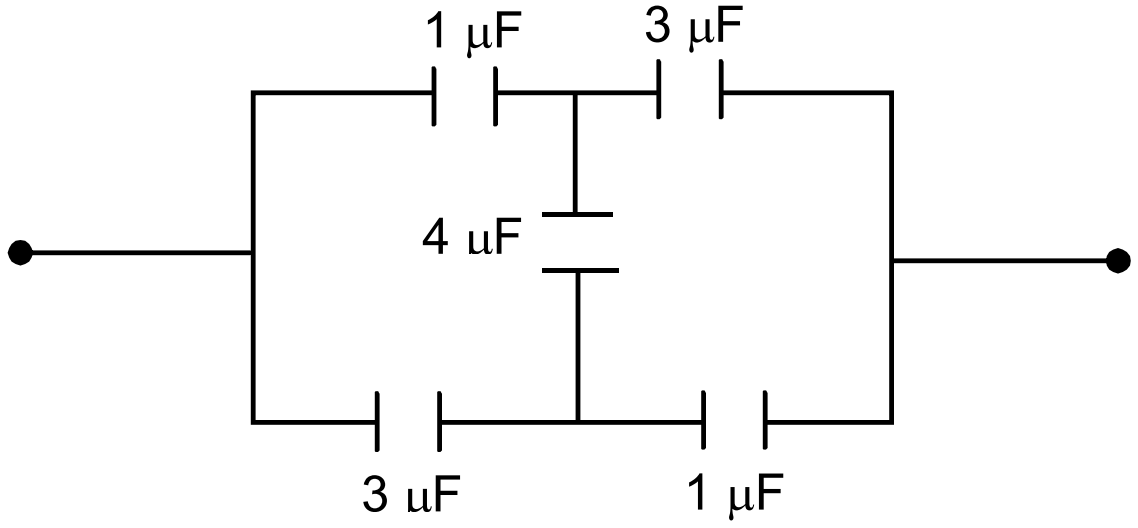
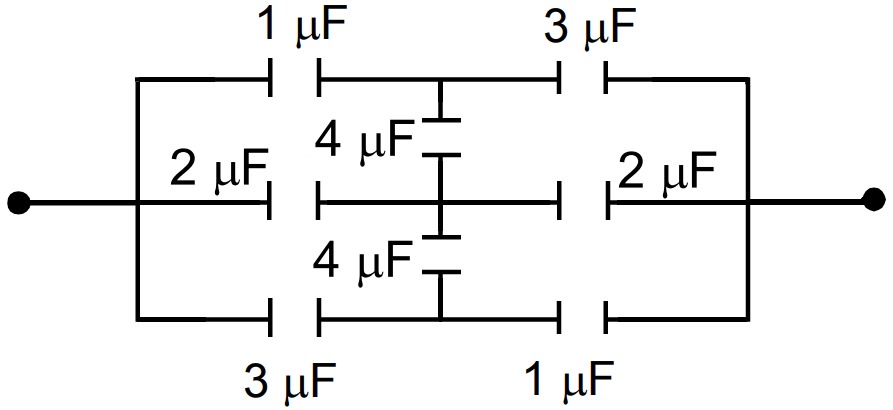
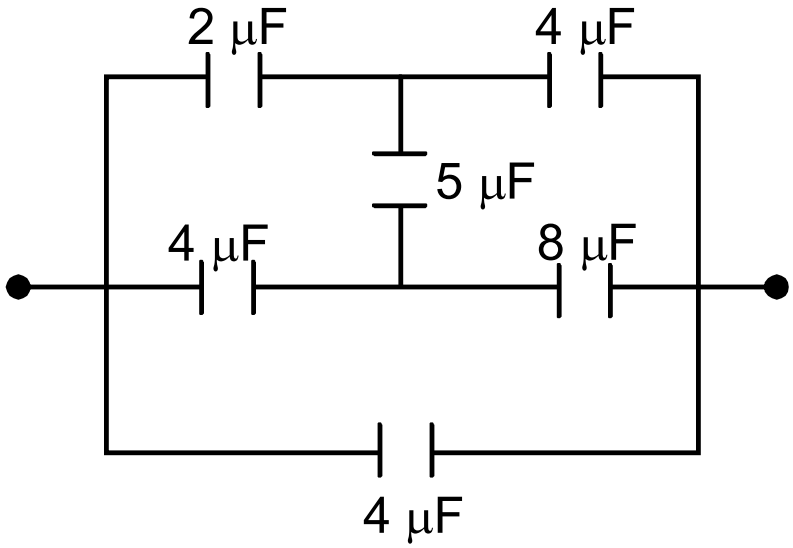
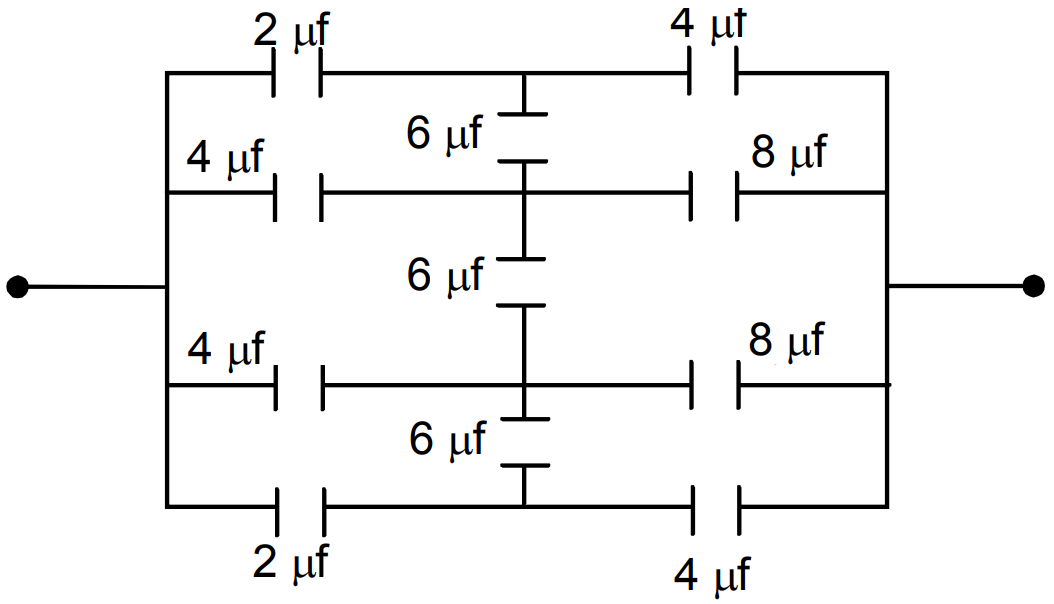
Find the equivalent capacitances of the combinations shown in figure between the indicated points.