MCQ
A compound was found to contain $5.37\%$ nitrogen. What is the minimum molecular weight of compound ?
  • A
    $26.07$
  • B
    $2.607$
  • $260.7$
  • D
    None of these

Answer

Correct option: C.
$260.7$
$5.37g$ of $N$ in $100g$ compound.
$14\text{g}\text{N}=\frac{100\times14}{5.37}=260.7\text{g}\text{ compound}$
Which is the minimum molecular wt as it should have at least one $N.$

Need a full question paper?

Generate a complete, print-ready paper with questions like this in minutes — across 16+ boards, with answer keys.

Start Generating Free

Similar questions

Moles of $\mathrm{Na}_2 \mathrm{SO}_4$​ to be dissolved in $12$ mole of water to lower its vapour pressure by $10$ millimeter Mercury at a temperature at which vapour pressure of pure water is $50$ millimeters?
The difference between bond orders of $\mathrm{CO}$ and $\mathrm{NO}$ is $\mathrm{NO}^{\oplus}$ is $\frac{\mathrm{x}}{2}$ where $\mathrm{x}=.....$

(Round off to the Nearest Integer)

Consider the following equilibrium $AgCl\downarrow +2N{{H}_{3}}\rightleftharpoons {{\left[ Ag{{\left( N{{H}_{3}} \right)}_{2}} \right]}^{+}}+C{{l}^{-}}$ White precipitate of $AgCl$ appears on adding which of the following
The $\ce{pH}$ of boiling water is $6.4$. This implies that boiling water is :
Which one of the following cannot be prepared by Wurtz reaction ?
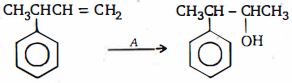
Reagent $A$ may be
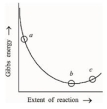
Consider the graph of $G i b b s$ free energy $G$ vs Extent of reaction. The number of statement/s from the following which are true with respect to points $(a), (b)$ and $(c)$ is $.................$

$A.$Reaction is spontaneous at $(a)$ and $(b)$

$B.$Reaction is at equilibrium at point $(b)$ and nonspontaneous at point $(c)$

$C.$Reaction is spontaneous at $(a)$ and nonspontaneous at $(c)$

$D.$Reaction is non-spontaneous at $(a)$ and $(b)$
What amount of energy (in $KJ$ ) is released in the combustion of $5.8\,gm$ of $C_4H_{10}\,(g)$ ?

$2{C_4}{H_{10(g)}}\, + \,13{O_{2(g)}}\, \to \,8C{O_{2(g)}}\, + \,10{H_2}{O_{(l)}}\,;$  $\Delta {H^o}\, = \, - \,5756\,KJ$

Octet rule is not valid for the molecule
Which of the following relation is correct with respect to first $(I)$ and second $(II)$ ionization potentials of sodium and magnesium