MCQ
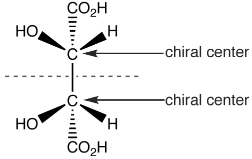
A compound whose molecules are superimposable on their mirror images even through they contain an asymmetric carbon atom is called
  • A meso compound
  • B
    An erythro isomer
  • C
    A threo isomer
  • D
    a glycol

Answer

Correct option: A.
A meso compound
a
Compound whose moelcules are superimposable on their mirror images even though it contain asymmetric carbon atoms is called a meso compound Due to presence of plane of symmetry, they are optically inactive even though contains chiral carbons.

Need a full question paper?

Generate a complete, print-ready paper with questions like this in minutes — across 16+ boards, with answer keys.

Start Generating Free

Similar questions

On heating ammonium dichromate, the gas evolved is
Osmotic pressure of a solution can be measured quickly and accurately by
Which of the following $3d$ bivalent metal ions has the smallest number of unpaired $d$ electrons
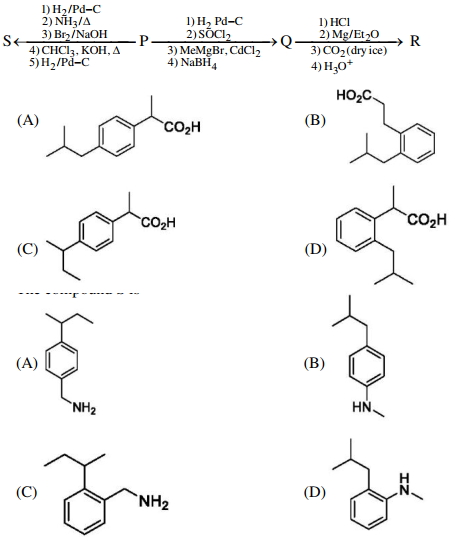
An organic acid $P \left( C _{11} H _{12} O _2\right)$ can easily be oxidized to a dibasic acid which reacts with ethyleneglycol to produce a polymer dacron. Upon ozonolysis, $P$ gives an aliphatic ketone as one of the products. $P$ undergoes the following reaction sequences to furnish $R$ via $Q$. The compound $P$ also undergoes another set of reactions to produce $S$.

(image)   

($1$) The compound $R$ is

(image) 

($2$) The compound $S$ is

(image) 

Give the answer or quetion ($1$) and ($2$)
$
CH_3 OH+PCl_5 \rightarrow
$
$
P \xrightarrow{\text { Mg/Dry ether }} Q \xrightarrow{HCHO} R \xrightarrow{H_2 O} S
$
"S" is:
Which of the following compound does not produce oxyacid of central atom on hydrolysis?
Match the coordination number and type of hybridisation with distribution of hybrid orbitals in space based on Valence bond theory.

Coordination number and type of hybridisation Distribution of hybrid orbitals In space
$(a)$ $4, sp ^{3}$ $(i)$ trigonal bipyramidal
$(b)$ $4, dsp ^{2}$ $(ii)$ octahedral 
$(c)$ $5, sp ^{3} d$ $(iii)$ tetrahedral
$(d)$ $6, d ^{2} sp ^{3}$ $(iv)$ square planar

Select the correct option

Chloride ion and potassium ion are isoelectronic. Then
Out of the following which gives blue colour on reaction with

$\xrightarrow{{P + {I_2}}}\,\xrightarrow{{AgN{O_2}}}\,\xrightarrow{{HN{O_2}}}\,\,\xrightarrow{{NaOH}}$

RNA and DNA are chiral molecules, their chirality is due to: